2018-06-24

Concert Review: Tokyo Ska Paradise Orchestra “Skanking Tour” in Matsuyama

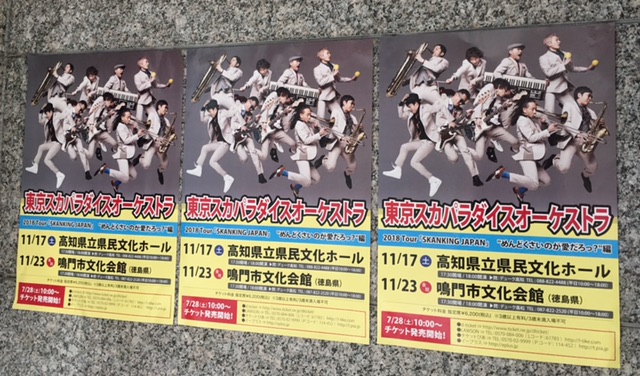
Posters at Matsuyama's w Studio Red.


(Click here for other posts about Tokyo Ska Paradise Orchestra)

Entering the venue.
I finally (finally!!!) got the chance to see Japan’s legendary Ska band Tokyo Ska Paradise Orchestra in Matsuyama, Japan, the last leg of their “Skanking Japan” livehouse tour.

I always prefer to see bands at their “home base” or home country if possible, so I was ecstatic to do so this time. But why Matsuyama? Well...by the time I found out about the tour, all the other locations were sold out! Plus, the date simply worked out better with my schedule. 

TSPO played at Matsuyama’s w Studio RED for two days (6/23 & 6/24); I attended the second show, the last show of the tour. Unfortunately for me, since I bought my ticket from overseas, I had to wait for quite awhile to get in. But the wait wasn’t long, and before I knew it I was inside, waiting for the guys to enter!

2018-01-17

Singapore: My General Impressions

Blue skies are the perfect background for the Marina Bay Sands hotel.
"What a fun city, but it's so...small." I thought in my hostel bunk on my last night in Singapore. 

Well, to be fair, great things can come in small sizes. Quality over quantity. You know all the bumper stickers sayings that back the little things in life. 

In terms of size, Singapore fits right in with those sayings as the core area of the city sits on a physically small area of space. But as all the David over Goliath phrases tell us, small things sure can pack a punch. I knew Singapore was a small city before, but I didn't realize that it was literally possible to visit all major districts and tourist spots in only two full days.

Night view of part of the Singapore skyline.
Visitors to the Republic of Singapore should know that it is a sovereign city-state, which means the city has its own government and therefore functions like it's own country.

In my opinion, one should not fly halfway across the world for the sole purpose of exploring Singapore. But if you you live in Asia and need a weekend getaway, or if you're planning a trip to Malaysia, the Philippines, Indonesia, ect., Singapore is worth two days in your itinerary. It's honestly one of the best places I've been to in terms of food and history, a place where Chinese, Indian, Malaysian and imperialistic British culture collide in an amalgamation of color, taste, and expressions. The diversity of Singapore is apparent as there are four official languages: English, Chinese, Tamil, and Malay.  

2017-08-06

Exploring the Sapporo Beer Museum

The iconic Sapporo Beer logo.
The museum entrance.
Known for it's annual snow festival, indigenous Ainu culture, and shiroi koibito(白い恋人)or "white sweetheart" cookies, the city of Sapporo is also synonymous with beer as Sapporo is the original home of the Sapporo Brewery. Hence, any visitor to the city must stop by the Sapporo Beer Museum(サッポロビール博物館).

Whether you're a beer aficionado or not (I am the former, ha!), the Sapporo Beer Museum is a great place to visit as it conveys Sapporo history from an interesting perspective. The iconic beer company not only introduced the well-known beverage to Japan, but was also a defining presence in the alcohol industry during both Japan's pre-WWII and economic miracle days. Today, the company has internationalized and is one of the most respected beer brewers in the world. In fact, it is the best-selling Asian beer in the world. 

2017-07-21

Album Review: Chara - Sympathy (2017)

Watabiki Miwa aka Chara
Source: chara-web.net
Watabiki Miwa—much better known as Chara—just celebrated over 25 years as an established artist. I have written extensively about her work here and will continue to chronicle and review her discography in future posts. However, I couldn't resist the opportunity to review her latest album Sympathy, released earlier this week. 

Although Chara will be 50 next year, and has spent almost half her life in the music industry, I believe Sympathy is indelible proof that her sound remains fresh and innovative. Sympathy includes some obvious weak links, but the star tracks shine through and demand several repeats, which makes this bittersweet album a whimsical summer gem. 

Sympathy (2017)
Source: musicman-net.com
While her sound has evolved and gone through many phases of experimentation through the years, one thing I love about Chara is that she's always unmistakably herself and never fails to be daring with her work. Sympathy is clearly a sensual album, a rare theme to spot in the work of a Japanese artist of Chara's generation. 

However, love and sensuality has been a running theme in Chara's work from her flirty, borderline exhibitionist early-90s days to her now more refined sultriness. Occasionally paired with her other common theme of innocences, this album serves romance on a wide, delectable gradient. To use an example from Chara's discography, this album is as if Madrigal (2001) had a baby with Chara's 2010s sound. There is a funky playfulness here that is hard to miss. 

Naturally, perfection is unattainable, so let's start with the weaker tracks in the album.

2017-07-10

Trippin' Out at the Seoul Trickeye Museum

Although they're getting visibly old, the paintings at Trick Eye Museum Seoul are gorgeous!
When you're an adult, it's refreshing to visit places that make you feel like a kid again. I'd say the best place to do that in Seoul is the Trickeye Museum. 

"I'm a genie in a bottle~"
With locations in major cities like Singapore, Hong Kong, and Phuket, the Trickeye Museum features numerous brilliantly painted sets where you can take fun pictures. As the name suggests, the sets play tricks on the eye. With the use of simple props and the extension of the paintings from the wall to the floor, visitors will have a blast posing for Instagram worthy photos. 

Some of the illusions require a bit of mild contortion to pull off (i.e., crouching and laying on the floor), but mosts guests will find the majority of the exhibitions accessible to them.

2017-05-08

WWII's Baby Nurses: Remembering the Himeyuri Students

The haunting portraits of the Himeyuri students displayed at the Himeyuri Peace Museum.
Source: Yahoo! Japan
"Whenever I saw dead bodies on the ground, I thought I wanted to die before the others so they could bury me. My fear was to be the last one on Earth." 
   --Hideko Yoshimura, Himeyuri survivor (Japan Times, 2007)
Although they attended high school in Japan over 70 years ago, the girls of Okinawa Daiichi Women's High School and Okinawa Shihan Women's High School were, in essence, like any other high school girls you'd find in any place at any time. They giggle with their friends, shared secrets, played sports, and studied hard as they worked toward graduation. But unlike many other high school girls, the young women from the two high schools were mad to grow up quickly during the chaos of the last days of World War II. Shooting and basic nursing care lessons progressively took precedence over math and Japanese classes. Eventually, they traded their school uniforms and classrooms for nursing outfits and crude cave clinics. By the end of the Battle of Okinawa, 12,000 American soldiers, 200,000 Japanese soldiers and civilians, and 136 Japanese schoolgirl nurses perished. 

The Iwamakura Monument on which is inscribed
a poem dedicated to the fallen girls written by
Mr. Seizen Nakasone, one of the Himeyuri teachers.
It was erected on April 7, 1946.
Even in the chaos of war, how could those girls have imagined losing their lives in cave bombings? What raced through the minds of those who held grenades to blow themselves up in order to avoid capture? What were the last thoughts of those who leapt off the capes at the southernmost tip of Okinawa island toward an imminent death in the beautiful turquoise ocean? 

And what of the survivors who had no choice but to leave their friends to die and live on with indelible memories of crude surgeries and the smell of death? 

The Himeyuri Peace Museum may not answer these questions for you, but after your visit, you will feel the pain of the Himeyuri or "Lily Corps" girls. You will feel their heartache and the echos of their unfulfilled wishes caused by tragic, untimely deaths. 

Himeyuri was the name given to the military nursing unit formed by 222 students and 18 teachers from the two women's high schools. After training as part of the curriculum in 1944, the girls were sent to the front lines on March 23, 1945 to assist the Imperial Japanese Army. 

2017-05-05

Reflection: 21 Solo Days Through East Asia

Overlooking the ocean in Okinawa.
Hiking, biking, laughing, crying...it seems I experienced it all when I took a 21-day trip through East Asia from mid-January to early February of this year.

I've taken a few solo trips before, but none were as long and extensive as this one. As day one of the trip approached, I felt a new kind of anxiety and excitement. 

Would everything pan out?

What would I learn about and see?

How would I hold up on such a long trip?

Have I finally gone too far?

I planned to travel by train, ferry, and airplane to each destination, just me and a suitcase. Expectations? I can't say I had any. Well, I knew I'd have to change currencies and SIM cards several times! But I truly didn't know what to expect. Comments from others on travel websites can only give a Pollock-style preview of what you might see on your travels. What others see and describe online may or may not be an accurate picture of your destinations. So, even in this technological age, traveling still means going off into the unknown.


2017-03-04

Exploring Old Guangdong: A Rainy Day in Dapeng Village

The front gate of Dapeng Fortress
I went on a day trip to Dapeng(大鵬), a subdistrict in Shenzhen about an hour and a half away from the city center. Aside from being conveniently close to the coastline, Dapeng is a great place to visit to explore the history of the area before Shenzhen's formation.

Signage is in English
and Chinese
My day trip was slightly interrupted by the rain, but I was able to throughly explore Dapeng Fortress(dapeng suocheng; 大鵬所成)and Dongshan Temple(dongshansi; 東山寺). 

I took bus E11 from Shenzhen North Station(shenzhenbei; 深圳北), and got off at Dapeng Station(dapengzhan; 大鵬站). Then, I walked to Dapeng Station #2(dapengzhan er; 大鵬站二)and took but 928 directly to the fort. Travel time was about two hours, but the scenery was interesting at many points so it didn't bore me. Plus I had a great book in tow. 

Dapeng Fortress was build in 1394 to protect citizens from pirates. Almost 200 years after it was built, the fortress was attacked by the Japanese. Nevertheless, the complex is largely still intact. A beautifully antiquated place, the fortress has clearly been restored, but it still retains it's age regally. 


Old homes

探險廣東:下雨天在大鵬

大鵬所成大門口
有英文的指路標誌,
對我門外國朋友很方便!
我去年去大鵬,當天來回的旅行。在大鵬,人不僅有機會看美麗的海邊,而且可以了解深圳地區的歷史。我下雨天去大鵬,但是我全面地探險大鵬所城和東山寺。

我從深圳北地鐵站出發,上了E11號公車,在大鵬站下。然後,我走到大鵬站二(只要大概五分鐘)上928號公車,在大鵬所城站下了。坐交通的時間一共差不多兩個鐘頭。對,很張的時間,但是有很多有漂亮景色的地點,所以沒有無聊,並且我帶來了一本很有趣的小說。

大鵬所成是1394改了為了保戶住在裡面的公民。雖然十六世紀日本軍隊襲擊了大鵬所城,但是它保存完好。真的是個漂亮的名勝古跡。很清楚,是以前恢復的地方,可是有古城的感覺。

老房子

2017-02-16

A Rainy Day in Shibuya and Harajuku (Part 2)

Forty years of deliciousness.
Takeshita Street
The modest Harajuku Station.
Map of Harajuku — click to englarge
Source
After visiting Meiji Shrine, I made my way deeper into Harajuku to have lunch and do some shopping. Of course, I spent quite a bit of time on the well-known Takeshita Street, which is right across the way from the small, humble Harajuku Station.
As it was rainy, cold, and not peak tourist season, Takeshita Street wasn't unbearably crowded, though there were quite a few people. There are several shops on the street where you can buy some of the latest Japanese fashions for cheap, or eat a yummy meal. 


Marion Crepes
Part of the yummy sweet and savory selections.
Although there is a wide variety of cute, interesting eateries on Takeshita Street, a stroll down Harajuku's most popular lane would arguably be incomplete without a visit to the well-known Marion Crepe, which has been in business for nearly 40 years—quite impressive!

Unlike Western-style crepes, Japanese crepes (which, in terms of style and fillings, are more or less identical to Taiwanese crepes often seen in night markets) are hand-held, cone shaped treats. Like their Western counterparts, Japanese crepes can be sweet or savory, but the combinations solidly deviate from the original treat (i.e., pizza and cheesecake...yes, a crepe with a piece of cheesecake in it!)

I visited Marion Crepe for lunch a few hours after a small breakfast, so I was hungry by the time I made my way there. At any given time, they offer tens of flavors, some of which are limited or seasonal. Generally, I don't like super sweet food—especially on an empty stomach—so I choose one of their snack crepes, which are savory and perfect for a lunch on the go.


2016-11-22

Album Review: Metafive - EP METAHALF (2016)


Takahashi Yukihiro & Metafive - Source: Natalie.mu
After releasing Meta (2016), which can arguably be deemed the best Japanese alternative/techno album of this year, Metafive have made their rounds this year performing a several Japanese music festivals including Summer Sonic and World Happiness. Behind the scenes, the band was also recording new music, and nearly two weeks ago, they dropped an EP or mini-album—Metahalf.

Metahalf (2016)
Source: hmv.co.jp

If you've heard Metafive—or any of the six member's solo works—it goes without saying that they're a group of highly skilled musicians. Nonetheless, Metahalf just does not deliver in the same way that Meta (2016) did. That's not to say that Metahalf isn't a quality EP, it just lacks some of the magic that it's predecessor had. That being said, Meta (2016) is a rare album in that all tracks contain something special, a feat that's quite difficult and somewhat rare for an artist to produce back-to-back. 

It's usually better to get the bad news out of the way first, so let's start with the last two tracks of Metahalf, the weak links: "Peach Pie" and "Submarine". 

2016-08-14

Reading in Chinese: Choosing Materials and Tackling Unknown Vocabulary

Pages from the popular Japanese comic Card Captor Sakura translated into Chinese.
Source
Last month, I finished teaching a summer Test of English as a Foreign Language (TOEFL) course. At the end of the course, I asked students if they had any general questions for me regarding English learning. Some asked pretty much the question many other English language learners I meet in my daily life ask:

"How should I study vocabulary? Should I memorize? I heard memorization is the best method."

Indeed, in China and other Asian countries, rote memorization is used not only to cram for tests, but to tackle any content thrown at students in the variety of classes they take. I believe there is a time and place for rote memorization (i.e., math formulas), but if you want language to be memorable, memorization is the wrong road to take. 

As an English teacher who loves to use the principals of cognitive linguistics or logic to tackle language, I believe vocabulary, grammar, or any other facet of language is only retained when it's contextualized, and/or when we know the etymology or background. Whether you're learning English, or Chinese and Japanese in my case, this rings true. I remember words and phrases from memorable conversations or interesting books. Naturally, when words and phrases are heard or read in context, they make more sense. 

I'll make a post about listening to Chinese in the future; this one concerns Chinese reading. (I don't know enough Japanese yet to read books, only short comics and signs!) Again, no matter the language you're learning, I think these tips will help you. 

Record five unknown vocabulary words per page

Recently, an employee at my local Walmart (yes, they're here in China!) struck up a conversation with me. He asked the typical memorization question, and I told him a better way to brush up on English is to read and write down about five words per page that you don't understand to check the definition later. 

"But what if there's more than five words I don't understand on a page?" he asked.

I replied, "Ignore them!"

2016-08-01

A Rainy Day in Shibuya and Harajuku (Part 1)

Barrels of sake at Meiji Shrine in Harajuku.
On my fourth day in Tokyo, I visited Shibuya and Harajuku. It was rainy and cold—as it was for most of my trip—but with rain boots, an umbrella, and a heavy jacket it certainly wasn't difficult to bare.

Although the neighboring areas of Shibuya, Harajuku, and Shinjuku are easily accessible by metro and other forms of public transportation, I elected to walk. On foot, it only takes about 20 minutes to reach Harajuku from Shibuya.

Hachiko in all his wonder.
It's raining, it's pouring!


Hachikō

The first place, or landmark, on my Shibuya-Harajuku agenda was the famous Hachikō statue just outside Shibuya station. Hachikō was a dog who waited around Shibuya Station for his owner Professor Hidesaburō Ueno who would meet him there after work. Unfortunately, the professor died from a brain hemorrhage and never meet his dog at the station again. Nonetheless, the loyal Hachiko waited for his owner outside the station for over nine years until he died in 1935 at age 11. 

After Hachikō's death, a statue of him was erected at the station in his memory. Over the years, the Hachikō statue has become a prominent meeting area for Tokyoites. Shibuya is an area teeming with crowds, so the noticeable statue serves it's secondary purpose well. 


2016-07-26

8th Annual Shenzhen Cartoon and Animation Festival

Cosplayers from a variety of series.
Two gorgeous maidens


Awesome weaponry!

Last week, a friend and I attended the last day of Shenzhen's 8th annual Cartoon and Animation Festival(第八深圳動漫節). The event spanned five days (July 21-25, 2016) and offered anime fans from Guangdong Province and beyond a chance to share their love of their favorite series and characters.

Edward Elric from
Fullmetal Alchemist
Kakashi from Naruto
From my childhood to my young adult years, I attended several anime conventions and have even donned costumes to attend these events as well. These day, I no longer make an effort to go to such events, but I though it be great fun to attend my first non-American anime convention!

The Shenzhen Cartoon and Animation Festival did not disappoint! Tickets were a fair 50RMB (about $7USD) and there were several impressive costumes, fun games, and cute things on sale to buy.

Costume Play

Costume + play = cosplay! Anime fans love to bring their beloved characters to life by dressing as them at conventions. Some buy their costumes, while other majorly talented fans create their own from scratch. Either way, it's entertaining to see them get into character, especially when they look eerily similar to their fictional counterparts!

2016-07-20

Music Musings: Metafive (2014-Present)

Yukihiro Takahashi (third from left) & Metafive - Source: Natalie.mu
Originally posted on the now-defunct Japanistas.com.

With his penchant for classy hats and Thom Browne suits, friendly grin, and slightly raspy timbre, 64-year-old Yukihiro Takahashi hardly appears to be a techno composer or a drumming powerhouse — but appearances can be deceiving!

Beyond Takahashi’s stylish exterior lies a lifelong musical innovator with an impressive number of successful projects under his belt. An industry pioneer, Takahashi has helped mold electronica, j-pop, synthpop, new wave and even hip hop music as we know it today, and he continues to do so through his super group Metafive: recording artist and producer Keigo Oyamada aka Cornelius; Japanese-Swedish singer/songwriter Leo Imai; electric instrumentalist, Tomohiko Gondo; former Denki Grove member and DJ, Yoshinori Sunahara; and DJ and record producer, Towa Tei.

Takahashi’s formal introduction to the music industry came from his time as the drummer in the Japanese British glam rock-inspired group Sadistic Mika Band, known best for their acclaimed 1974 album Kurofune(黒船), “Black Ships”.


As the first Japanese band to tour the United Kingdom, the Sadistic Mika Band’s unique sound drew attention, especially regarding their ability to create Western-style music in an undoubtedly Japanese manner. They went on to appear on both BBC Radio and BBC TV.

Nevertheless, The Sadistic Mika Band in its original form disbanded in the mid-70’s, yet there have been a number of revivals of the band under several names over the years, including a 2006 revival with Kaela Kimura in Mika Kato’s place.

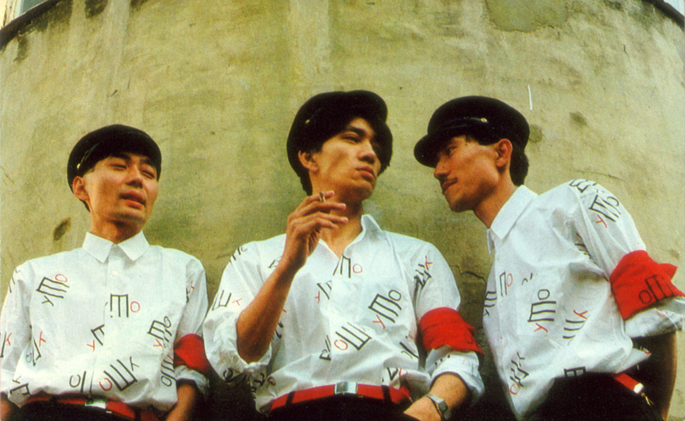
After Sadistic Mika Band’s disbandment, Takahashi went on to begin a successful solo career. Simultaneously, he was a member of world-renowned group the Yellow Magic Orchestra along with bassist, producer, and songwriter Haruomi "Harry" Hosono, and composer, pianist, and two-time Golden Globe, Academy, and Grammy award-winner Ryuichi Sakamoto.

The Yellow Magic Orchestra in the early 80’s. – Source: Factmag.com
Created by Hosono, YMO was meant to be a temporary project, but after gaining international recognition, the band played spectacular lives and recorded esteemed albums together for several years.

2016-04-18

Black Women Thrive: Interview with English Teacher Ayana Wyse

English teacher Ayana Wyse
Whether you're facing uncertainty or simply a little nervous, sometimes in life you have to just go for it like Ayana Wyse did when she made the decision to move to Osaka, Japan nearly five years ago after she started learning Japanese on her own while still living in Brooklyn, New York.

"I decided to live [in Japan] after months of studying because I wanted to try a new life, learn the language in the country and was inspired by my friend who lived in Japan for a few months."

Actually, before moving to Japan, Wyse had some experience being out of her element and changing her scenery stateside in New York. After growing up in a predominately White area in the county of Westchester, New York, she was happy to move White Plains, the more diverse area of the county. Nonetheless, her Black peers were well aware of her less divergent background. 

"I was excited to...experience a new [high school] with new people and more diversity. When I went there though, many of the Black people teased the way I talked...I still made an effort to befriend mostly Black people so I didn't have to stick out so much any more although now I'm back to being one of the few Black again [in Japan]."

Although Wyse's peers might've felt she was not in touch with Black culture, in reality, Wyse and her older brother—five years her senior—grew up being educated about her Caribbean and by extension African roots as her father is from Grenada.

Like other kids of the 90s, Wyse and her older brother also enjoyed Japanese pop culture in the form of anime. Rouroni Kenshin; Tenchi Muyo; Pokemon; Digimon; and Yu-Gi-Oh! were a few of their favorites.

"My brother was interested in anime first with Dragon Ball and I with Sailor Moon. At the time, I didn't know it was from Japan." 

Later, Wyse began to learn about other aspects of Japanese culture, and became particularly interested in geisha and samurai. Eventually, she studied at two colleges. However, she majored in Communications rather than Japanese. 

"First I went to Seton Hall...[which] had a good track and field team which [I] entered in...I transferred to University of North Carolina in Charlotte after two years for a better track team."

At UNC Charlotte, Wyse majored in Communications since there was no Japanese major. However, she changed her mind about working in media after she graduated. Two years after graduation, she took inspiration from her childhood best friend who worked as an ALT (assistant language teacher) in Japan for six months, and from her brother who was studying Brazilian Portuguese when she began to teach herself Japanese after college.

"It was the year 2010 in January [that] I made a New Year's resolution to study a new language because I saw my brother learn Brazilian Portuguese and I worked at a cafe in NYC where the owners spoke English and Hebrew, and the cooks were Spanish. Everyone being able to speak more than one language made me jealous, so...I tried to fix that by learning Japanese on my own."
2016-02-23

Restaurant Review: Marukame Udon, Waikiki

Source
Sluuurp!
The Waikiki area of Honolulu is notoriously expensive. If you're staying or spending the day in Waikiki, you'll be hard-pressed to find delicious, affordable food. As Waikiki was home-base during my trip to Hawaii, I did research on good eats in the area with a reasonable price tag. Based on the rave online reviews and my experiences, I believe Marukame Udon is the undisputed winner in that category!

For almost five years, Marukame Udon has been serving up the best bowl of thick, chewy Japanese-style wheat noodles or udon(うどん)in Waikiki. The noodles are made fresh to order; in fact, thanks to the restaurant's open kitchen, you can watch the chefs make them as you wait in line!

2016-02-02

Lots of Temples, Lots of People: Visiting Kaohsiung's Lotus Pond

The famous Dragon and Tiger Pagodas (longhuta; 龍虎塔).
Me taking several pictures as usual!
Many of the sites I visited in Kaohsiung were gorgeous and interesting; Lotus Pond was no different! Like the day we went to Cijin Island, my dad and I were blessed with beautiful weather when we visited the pond. You can tell by the bright blue sky in the pictures, right? I still find it hard to believe it was in the middle of winter! Southern Taiwan is definitely a great place to be in the during wintertime if you love warmer weather. 

Lotus Pond has quite an interesting history. The "pond" is actually a large manmade lake which was opened to the public in 1951. While the lake is a contemporary fixture, many of the sites around it have roots in antiquity. There are several temples, halls, pavilions, and palaces around the lake from centuries past. The area certainly has a nice ethereal feeling to it. 

I think it would take the better part of an afternoon to see all the sites at Lotus Pond, but you'd certainly be tired from all the walking afterward! Luckily, there is a long pedestrian road with several food venders right next to the lake so you can walk around a refuel simultaneously! 
A map of Lotus Pond, click to enlarge.
Source

Nonetheless, my dad wasn't up to the task of walking around the whole lake, so we only saw the Dragon and Tiger Pagodas(longhuta; 龍虎塔), Confucian Temple(kongmiao, 孔廟), Spring and Autumn Pavilions(chunqiuge; 春秋閣), and the Pei Chi Pavilion(beijiting; 北極亭). As we had to shuffle through crowds, it certainly felt like enough!

美麗的寺廟和很多人:參觀蓮池潭

龍虎塔
我拍了很多很多照片!
如果你搬去住在台灣,你會注意新的飯館開門的時候,會有很長的線在外邊。跟寺廟很像;有寺廟會有很多人。逛街的人,聊天,享受好的天氣,去老街買小吃。我很喜歡那個熱情的“寺廟的文化”。

因為在蓮池潭的寺廟很多,所以我覺得我說的“寺廟的文化”很重。要是你去高雄,你必須參觀蓮池潭 。不管天氣好不好,蓮池潭的寺廟也會把你迷住了,我覺得。給我在世界跟天堂的中間的感覺。
蓮池潭地圖。點擊看大圖。
Source

在一個下午,很容易看到蓮池潭的名勝古跡。地方很大,可是賣小吃的人很多。你可以一邊吃飯,一邊走路,不會胖哈哈!

我跟爸爸一起參觀蓮池潭。他不習慣每天多走路,所以我們只看龍虎塔孔廟春秋閣北極亭。我們還逛老街買東西吃。一般的說,是個放鬆的天。

2016-01-27

5 Ways I Study Japanese

Source
I have made several short, lackluster efforts over the past few years to study Japanese. I remember way back in junior high during my anime-obsessed days I rented a series of Japanese learning tapes from the library; however, I didn't dedicate myself to using them daily. Since then, my Japanese knowledge has been limited to phrases here and there that I've gotten from Japanese media, especially music and television. 

Nevertheless, over the past year or so I've been making efforts to learn more Japanese. Compared to Chinese, I think it's certainly a more difficult language in terms of the grammar and writing systems among other things. At least with Japanese, when it comes to speaking, there's only intonation to concern yourself with rather than tones.

See how I use Chinese to learn Japanese here.

Although Japanese challenges me, there are five methods I use to casually study the language and check what I've learned or how much I know. I'm conversational in Mandarin, but not Japanese; I think my strongest Japanese skill at the moment is reading. Nonetheless, hopefully I will be able to hold a decent conversation in Japanese by the end of this year.

1. Learn Kana & Practice it Everyday
A hiragana-katakana chart. Memorize it!
Source

There is simply no way one can learn to read and write Japanese efficiently without learning the kana systems, hiragana and katakana. Hiragana is used to write words of Japanese origin that do not have a corresponding kanji or Chinese-derived character. Katakana represents foreign/foreign-derived words and sounds. 

While you still need to know several kanji to read most Japanese text past early elementary level, there's a host of words you can read once you learn kana:
  • カレー (karē) - curry
  • おにぎり(onigiri) - Japanese rice balls
  • オレンジー (orenjī) - orange (the color)
  • ドキドキ (dokidoki) - badum, badum; onomatopoeia for a heartbeat
  • ハンバガ (hanbāgā) - hamburger
As you probably noticed, many of my examples are food items. Therefore, if you're taking a trip to Japan, I'd strongly recommend you to learn kana so you can articulate what you want to eat instead of pointing at displays! You can easily do it within a weekend.