Showing posts with label history. Show all posts

2018-01-17

Singapore: My General Impressions

Blue skies are the perfect background for the Marina Bay Sands hotel.
"What a fun city, but it's so...small." I thought in my hostel bunk on my last night in Singapore. 

Well, to be fair, great things can come in small sizes. Quality over quantity. You know all the bumper stickers sayings that back the little things in life. 

In terms of size, Singapore fits right in with those sayings as the core area of the city sits on a physically small area of space. But as all the David over Goliath phrases tell us, small things sure can pack a punch. I knew Singapore was a small city before, but I didn't realize that it was literally possible to visit all major districts and tourist spots in only two full days.

Night view of part of the Singapore skyline.
Visitors to the Republic of Singapore should know that it is a sovereign city-state, which means the city has its own government and therefore functions like it's own country.

In my opinion, one should not fly halfway across the world for the sole purpose of exploring Singapore. But if you you live in Asia and need a weekend getaway, or if you're planning a trip to Malaysia, the Philippines, Indonesia, ect., Singapore is worth two days in your itinerary. It's honestly one of the best places I've been to in terms of food and history, a place where Chinese, Indian, Malaysian and imperialistic British culture collide in an amalgamation of color, taste, and expressions. The diversity of Singapore is apparent as there are four official languages: English, Chinese, Tamil, and Malay.  

2017-08-06

Exploring the Sapporo Beer Museum

The iconic Sapporo Beer logo.
The museum entrance.
Known for it's annual snow festival, indigenous Ainu culture, and shiroi koibito(白い恋人)or "white sweetheart" cookies, the city of Sapporo is also synonymous with beer as Sapporo is the original home of the Sapporo Brewery. Hence, any visitor to the city must stop by the Sapporo Beer Museum(サッポロビール博物館).

Whether you're a beer aficionado or not (I am the former, ha!), the Sapporo Beer Museum is a great place to visit as it conveys Sapporo history from an interesting perspective. The iconic beer company not only introduced the well-known beverage to Japan, but was also a defining presence in the alcohol industry during both Japan's pre-WWII and economic miracle days. Today, the company has internationalized and is one of the most respected beer brewers in the world. In fact, it is the best-selling Asian beer in the world. 

2017-05-08

WWII's Baby Nurses: Remembering the Himeyuri Students

The haunting portraits of the Himeyuri students displayed at the Himeyuri Peace Museum.
Source: Yahoo! Japan
"Whenever I saw dead bodies on the ground, I thought I wanted to die before the others so they could bury me. My fear was to be the last one on Earth." 
   --Hideko Yoshimura, Himeyuri survivor (Japan Times, 2007)
Although they attended high school in Japan over 70 years ago, the girls of Okinawa Daiichi Women's High School and Okinawa Shihan Women's High School were, in essence, like any other high school girls you'd find in any place at any time. They giggle with their friends, shared secrets, played sports, and studied hard as they worked toward graduation. But unlike many other high school girls, the young women from the two high schools were mad to grow up quickly during the chaos of the last days of World War II. Shooting and basic nursing care lessons progressively took precedence over math and Japanese classes. Eventually, they traded their school uniforms and classrooms for nursing outfits and crude cave clinics. By the end of the Battle of Okinawa, 12,000 American soldiers, 200,000 Japanese soldiers and civilians, and 136 Japanese schoolgirl nurses perished. 

The Iwamakura Monument on which is inscribed
a poem dedicated to the fallen girls written by
Mr. Seizen Nakasone, one of the Himeyuri teachers.
It was erected on April 7, 1946.
Even in the chaos of war, how could those girls have imagined losing their lives in cave bombings? What raced through the minds of those who held grenades to blow themselves up in order to avoid capture? What were the last thoughts of those who leapt off the capes at the southernmost tip of Okinawa island toward an imminent death in the beautiful turquoise ocean? 

And what of the survivors who had no choice but to leave their friends to die and live on with indelible memories of crude surgeries and the smell of death? 

The Himeyuri Peace Museum may not answer these questions for you, but after your visit, you will feel the pain of the Himeyuri or "Lily Corps" girls. You will feel their heartache and the echos of their unfulfilled wishes caused by tragic, untimely deaths. 

Himeyuri was the name given to the military nursing unit formed by 222 students and 18 teachers from the two women's high schools. After training as part of the curriculum in 1944, the girls were sent to the front lines on March 23, 1945 to assist the Imperial Japanese Army. 

2017-05-05

Reflection: 21 Solo Days Through East Asia

Overlooking the ocean in Okinawa.
Hiking, biking, laughing, crying...it seems I experienced it all when I took a 21-day trip through East Asia from mid-January to early February of this year.

I've taken a few solo trips before, but none were as long and extensive as this one. As day one of the trip approached, I felt a new kind of anxiety and excitement. 

Would everything pan out?

What would I learn about and see?

How would I hold up on such a long trip?

Have I finally gone too far?

I planned to travel by train, ferry, and airplane to each destination, just me and a suitcase. Expectations? I can't say I had any. Well, I knew I'd have to change currencies and SIM cards several times! But I truly didn't know what to expect. Comments from others on travel websites can only give a Pollock-style preview of what you might see on your travels. What others see and describe online may or may not be an accurate picture of your destinations. So, even in this technological age, traveling still means going off into the unknown.


2017-03-04

Exploring Old Guangdong: A Rainy Day in Dapeng Village

The front gate of Dapeng Fortress
I went on a day trip to Dapeng(大鵬), a subdistrict in Shenzhen about an hour and a half away from the city center. Aside from being conveniently close to the coastline, Dapeng is a great place to visit to explore the history of the area before Shenzhen's formation.

Signage is in English
and Chinese
My day trip was slightly interrupted by the rain, but I was able to throughly explore Dapeng Fortress(dapeng suocheng; 大鵬所成)and Dongshan Temple(dongshansi; 東山寺). 

I took bus E11 from Shenzhen North Station(shenzhenbei; 深圳北), and got off at Dapeng Station(dapengzhan; 大鵬站). Then, I walked to Dapeng Station #2(dapengzhan er; 大鵬站二)and took but 928 directly to the fort. Travel time was about two hours, but the scenery was interesting at many points so it didn't bore me. Plus I had a great book in tow. 

Dapeng Fortress was build in 1394 to protect citizens from pirates. Almost 200 years after it was built, the fortress was attacked by the Japanese. Nevertheless, the complex is largely still intact. A beautifully antiquated place, the fortress has clearly been restored, but it still retains it's age regally. 


Old homes

2016-08-01

A Rainy Day in Shibuya and Harajuku (Part 1)

Barrels of sake at Meiji Shrine in Harajuku.
On my fourth day in Tokyo, I visited Shibuya and Harajuku. It was rainy and cold—as it was for most of my trip—but with rain boots, an umbrella, and a heavy jacket it certainly wasn't difficult to bare.

Although the neighboring areas of Shibuya, Harajuku, and Shinjuku are easily accessible by metro and other forms of public transportation, I elected to walk. On foot, it only takes about 20 minutes to reach Harajuku from Shibuya.

Hachiko in all his wonder.
It's raining, it's pouring!


Hachikō

The first place, or landmark, on my Shibuya-Harajuku agenda was the famous Hachikō statue just outside Shibuya station. Hachikō was a dog who waited around Shibuya Station for his owner Professor Hidesaburō Ueno who would meet him there after work. Unfortunately, the professor died from a brain hemorrhage and never meet his dog at the station again. Nonetheless, the loyal Hachiko waited for his owner outside the station for over nine years until he died in 1935 at age 11. 

After Hachikō's death, a statue of him was erected at the station in his memory. Over the years, the Hachikō statue has become a prominent meeting area for Tokyoites. Shibuya is an area teeming with crowds, so the noticeable statue serves it's secondary purpose well. 


2016-01-12

Morris Thompson Cultural & Visitors Center

With its clear signage and prominent location at the edge of downtown,
Morris Thompson Cultural & Visitors Center can't be missed.
A beautiful display of indigenous clothing
and other items.
The Morris Thompson Cultural & Visitors Center is a free attraction not far from downtown Fairbanks. The center is open to the public between 8am and 9pm daily, which allows visitors to choose a flexible time to stop by. 

While most tourist centers mainly offer brochures and a couple of staff members you can quiz for advice regarding your trip, the Morris Thompson Center virtually doubles as a free museum. It's easy to spend an hour or more there exploring the exhibits, taking in all the artifacts on display, and simply learning about life in the Last Frontier. Many of the stories shared within the exhibits are centered on the people—both relatively famous and virtually unknown—who have helped carve Fairbanks and more generally Alaska into what it is today.

The Visitors Center includes a gorgeous garden.
One of those people is the late Alaska Native leader Morris Thompson for whom the center is named. Thompson, who had a White father and Native mother, became an assistant for the Bureau of Indian Affairs in the early 70s, and later became the youngest Commissioner of the Bureau of Indian Affairs. He also served on the University of Alaska Board of Regents. Tragically, Thompson died in the Alaska Airlines Flight 261 crash with his wife and one of his three daughters in 2000. The Morris Thompson Cultural & Visitors Center was completed and dedicated to him in 2008.

2015-12-08

Xuanmiao Temple: Suzhou's Old Centerpiece

Xuanmiao Temple's San Qing Hall seen from the side.
The temple's main paifang or
decorative gate.
The Taoist Xuanmiao Temple(xuanmiao guan; 玄妙館)—"Mysterious Sublimity Temple" or "Mysterious Essence Temple"—dominates the center of Suzhou. Even so, it was not on my class' itinerary! Had I not decided to explore the city center with some classmates, I would have never visited this charming temple. 

Located on Guanqian Street(觀前街), a famous pedestrian lane, Xuanmiao Temple's bright gold paint and predominant gate are difficult to miss. Initially built in 276 AD and named Zhen Qing Dao Yuan(真慶道院), the temple was destroyed during the Song Dynasty, and then rebuilt and renamed in 1264. It was damaged yet again in the 18th century and repaired in 1775. 

2015-10-27

The Summer Palace: A World of Color

The gorgeous Marble Boat, also known as the Boat of Purity and Ease,
which sits on Kunming Lake.
A map of the Summer Palace
(click to enlarge).
Source
The Summer Palace(Yiheyuan; 頤和園)is a 1.1 square mile (2.9 square meter) compound of temples, residences, and gardens formerly occupied by Chinese nobility. Longevity Hill(wanshoushan; 萬壽山)and Kunming Lake(kunminghu; 昆明湖)dominate most of the land. Like many antiquated areas of Beijing, nature is the focal point of the Summer Palace, which was designated a UNESCO World Heritage Site in 1998. However, I didn't find this to be the case in the Forbidden City, which has a more solemn feel in my opinion. 


People taking a rest.
While the location of the Summer Palace goes back as far as the Jin Dynasty (1115-1234), the palace as it's known now was established during the Qing Dynasty (1644-1912). After part of it was destroyed during the Second Opium War (1856-1860), the infamous Empress Dowager Cixi used money allocated for the navy to rebuilt it for her 60th birthday.

In regards to ancient sites, the Summer Palace was my favorite stop in China. Unfortunately, my class suffered time restraints like we did when visited the Forbidden City. As a result, we only had about two hours to explore the massive palace. Nevertheless, my classmates and I somehow made it work and we were able to see several of the main temples and halls in the palace.

2015-09-15

The Forbidden City (故宮)

My photograph of the Forbidden City in 2011.
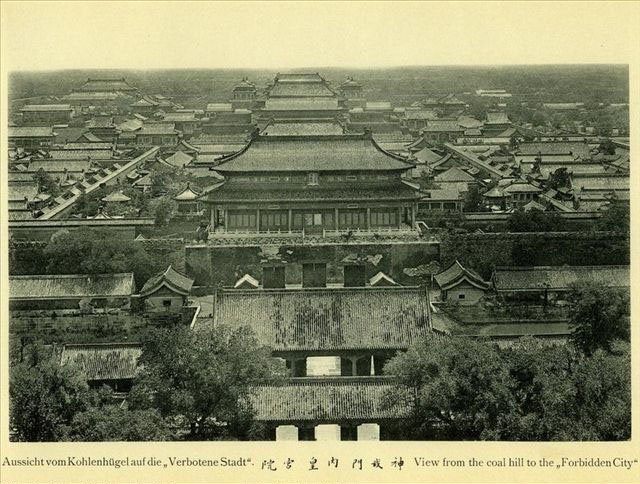
The Forbidden City in 1900.
Source 
The Forbidden City or gugong (故宮)was crowned a UNESCO World Heritage site as it is considered the best preserved set of wooden structures in the world. It served as the imperial palace for emperors beginning in the Ming Dynasty until the end of the Qing Era, the last of China's dynasty periods. Construction began on the Forbidden City in 1406 under the charge of the Yongle Emperor Zhu Di, and it was completed in 1420. The city is about 180 acres and includes nearly 1,000 buildings.

As the Forbidden City is one of the most popular tourist attractions in Beijing—if not China—the area was completely crowded on the summer weekend my class visited. In addition, several local visitors wanted to take pictures of us. It was almost like we were a free attraction, especially for the family that had their hands in my braids at the entrance—strangely amusing!

Despite the occasional unwanted attention, I was happy to visit the Forbidden City as it is so well preserved. However, our class schedule was tight and we were only given two hours to explore, not nearly enough time to see everything. At least, I think a person would need half a day to thoroughly enjoy the Forbidden City. 

2015-08-29

The Römisch-Germanisches Museum

The museum with a glimpse of the Dom on the left.
The Römisch-Germanisches Museum or Roman-German Museum (RGM) is an archeological museum conveniently located next to the Dom and Schildergasse across from Cologne Main Station, so there's no excuse not to visit!

Like many other museums in Europe, students under the age of 25 who produce a students card are able to receive a discount on their admission ticket. When I visited the museum (June 2014), student admission was just over 3 euros (~$3.35). 

2015-08-18

Honolulu: My General Impressions


The view of Honolulu from the
Diamond Head crater.
I am going to be brutally honest in this post. I think Honolulu is, albeit beautiful, one of the saddest places I have ever visited.

Western imperialism and its depressing results have left deep scares on the city. I use the term "Western" because it is clear that the Hawaii is in no way, shape, or form a Western island, although it has been part of the United States for over 50 years. The atmosphere in Hawaii is so different it may as well be a different country. Wait—it was before.

Queen Lili'uokalani
Source
The Hawaiian kingdom was overthrown in part by the American Dole Food Company, which was founded by Samuel B. Dole, Hawaii's president after the coup d'etat that overthrew Hawaii's last monarch, Queen Lili'uokalani. Although she attempted to have a say in the new government before the coup, she was ultimately silenced and essentially shutout from molding the future of her own land. Why? Long story short, Dole and the United States were money-hungary and wanted to rape Hawaiian land for all they could get. (Thanks Dole Food Company. I'll stick with Turbana).

Hawaii's unfortunate history aside, did I generally enjoy my time in Hawaii? No. Why? Because of the melancholy.

Once you leave Waikiki, the degradation, homelessness, and destitute nature of the area is obvious. The natives have been pushed to the edge of the island due to insane property costs, and big companies as well as rich folks from the Mainland are beginning to buy up a lot of the land. By the time I left Hawaii, I felt guilty for vacationing there and indirectly promoting the marginalization of the people. (Granted, the trip was my dad's idea, not mine. I've honestly never been keen on visiting Hawaii).

Good luck if you plan on vacationing in Hawaii. Most activities are overpriced, and food is quite costly as well. Parking is hell, so don't rent a car. My dad and I found ourselves either driving around, walking about aimlessly, or eating cheap food. I think hiking in Diamond Head and visiting the Hawaii State Art Museum were the highlights of our trip. After all, those activities cost us $1 and nothing respectively, but I genuinely enjoyed those two stops. Oh, and we fell in love with eating at Marukame Udon.

2015-08-11

Sensō-ji Temple(浅草寺): Recreation + Religion

In front of the main gate, Kaiminarimon(雷門)
with a big chōchin (提灯)or lantern.
A map of my Day 1 walking tour.
Source
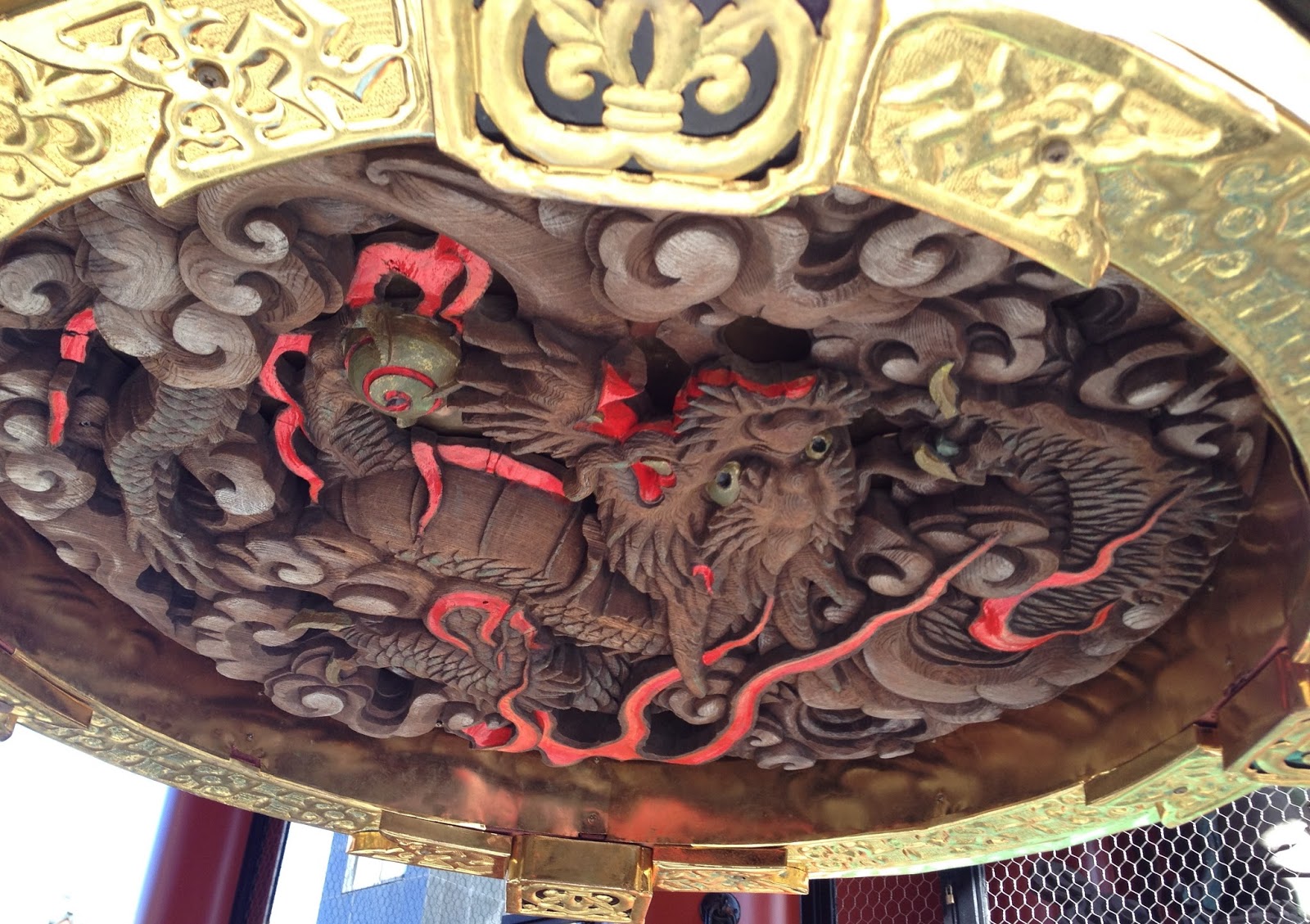
The impressive handiwork
under Kaiminarimon's lantern.
Traveling is like a drug to me. I seemingly have unlimited energy when I'm on a trip because I want to see everything. Although it's not possible to see all the main sites in Tokyo during one short trip, I packed my days as much as I could, yet I ended up crashing on the fifth day, and aside from going to Tsukiji Fish Market, I did nothing but walk around the neighborhood where I stayed, buy a pair of cute socks at the grocery store, and sleep! However, my first full day in Tokyo heavily contrasted my fifth; I went to the Tokyo Skytree area, Asakusa, Kappbashi, Ueno, and Tokyo Station Character Street! Furthermore, I footed it from Tokyo Skytree to Okamachi Station(岡町駅)and took in all the alleys and neighborhoods in between, then hopped on the train to Tokyo Station. That day, I walked for around eight hours. Maybe I'm a little crazy, but I love walking, what can say?

Sensō-ji Temple's famous
five-story pagoda(五重塔; gojūnotō)
Many of the areas I passed through on my first day in Tokyo deserve their own posts; this one focuses on Sensō-ji Temple(浅草寺)in Asakusa(浅草).

Along with Meiji Shrine(明治神宮), I think Sensō-ji Temple—also known as Kinryū-zan Sensō-ji (金龍浅草寺)—is one of the most famous temples in Tokyo. While both shrines are well-known, they are associated with different religions, Shintoism and Buddhism, respectively. Additionally, Sensō-ji Temple is the older of the two. By how much? Well, Sensō-ji Temple was originally founded in 645, and Meiji Shrine was constructed in 1920—you do the math!

Sensō-ji Temple is dedicated to Avalokiteśvara; two brothers supposedly saw a statue of the bodhisattva in the Sumida River near the location of the current shrine. The temple was bombed during World War II and subsequently rebuilt, thus the shrine also symbolizes rebirth.

2015-08-01

Huwei Fort(滬尾砲台)

Huwei Fort's entrance.
滬尾砲台的門口。
滬尾砲台(英語:Hobe Fort)是在淡水的名勝古跡之一。去這砲台很簡單,從捷運淡水站坐紅26公車到 “滬尾砲台站”;從公車站不太遠。

Huwei Fort (also known as Hobe Fort) is one of the historical landmarks of Danshui. It is easy to access; just ride the R26 bus from Danshui Station to "Huwei Fort". It's a short walk from the bus stop.

中法戰爭(1884-1885)的時候,為了加強台灣的港口,清朝政府建了一些砲台。說到砲台的樣子,劉銘傳州長決定了德國式砲台是最好的因為他發現外國軍隊的砲台比較強。一開始有兩座砲台在淡水,但是別的被摧毀了。
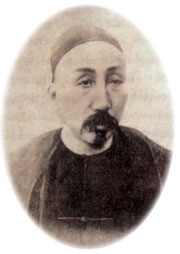
Governor Liu Ming-Chuan
劉銘傳州長
Source

During the Sino-French War (1884-1885), the Qing Dynasty government built a number of forts to strengthen Taiwan's ports. Speaking of their design, Liu Ming-chuan - the governor of Taiwan - decided German-style forts would be the best because he noticed foreign forts were stronger. In the beginning, Danshui had two forts, but one was destroyed.

因為在滬尾砲台沒有戰鬥,所以現在它差不多跟以前一樣。墻,門,和房的好狀態把我迷住了。我有在19世紀的感覺!我覺得去滬尾砲台很像坐上時間機器。

Because Huwei Fort never saw battle, it looks almost the same now as it did when it was built. The walls, doors, and rooms fascinated me because they are is such great condition. I felt like I was in the 19th century! I think going to Huwei fort is like riding a time machine.