Showing posts with label Japan. Show all posts

2018-06-24

Concert Review: Tokyo Ska Paradise Orchestra “Skanking Tour” in Matsuyama

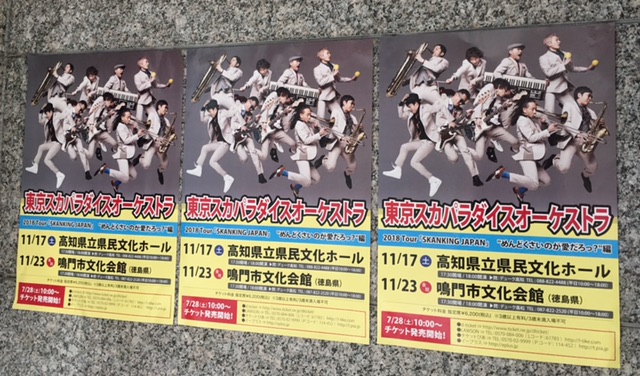
Posters at Matsuyama's w Studio Red.


(Click here for other posts about Tokyo Ska Paradise Orchestra)

Entering the venue.
I finally (finally!!!) got the chance to see Japan’s legendary Ska band Tokyo Ska Paradise Orchestra in Matsuyama, Japan, the last leg of their “Skanking Japan” livehouse tour.

I always prefer to see bands at their “home base” or home country if possible, so I was ecstatic to do so this time. But why Matsuyama? Well...by the time I found out about the tour, all the other locations were sold out! Plus, the date simply worked out better with my schedule. 

TSPO played at Matsuyama’s w Studio RED for two days (6/23 & 6/24); I attended the second show, the last show of the tour. Unfortunately for me, since I bought my ticket from overseas, I had to wait for quite awhile to get in. But the wait wasn’t long, and before I knew it I was inside, waiting for the guys to enter!

2017-08-06

Exploring the Sapporo Beer Museum

The iconic Sapporo Beer logo.
The museum entrance.
Known for it's annual snow festival, indigenous Ainu culture, and shiroi koibito(白い恋人)or "white sweetheart" cookies, the city of Sapporo is also synonymous with beer as Sapporo is the original home of the Sapporo Brewery. Hence, any visitor to the city must stop by the Sapporo Beer Museum(サッポロビール博物館).

Whether you're a beer aficionado or not (I am the former, ha!), the Sapporo Beer Museum is a great place to visit as it conveys Sapporo history from an interesting perspective. The iconic beer company not only introduced the well-known beverage to Japan, but was also a defining presence in the alcohol industry during both Japan's pre-WWII and economic miracle days. Today, the company has internationalized and is one of the most respected beer brewers in the world. In fact, it is the best-selling Asian beer in the world. 

2017-07-21

Album Review: Chara - Sympathy (2017)

Watabiki Miwa aka Chara
Source: chara-web.net
Watabiki Miwa—much better known as Chara—just celebrated over 25 years as an established artist. I have written extensively about her work here and will continue to chronicle and review her discography in future posts. However, I couldn't resist the opportunity to review her latest album Sympathy, released earlier this week. 

Although Chara will be 50 next year, and has spent almost half her life in the music industry, I believe Sympathy is indelible proof that her sound remains fresh and innovative. Sympathy includes some obvious weak links, but the star tracks shine through and demand several repeats, which makes this bittersweet album a whimsical summer gem. 

Sympathy (2017)
Source: musicman-net.com
While her sound has evolved and gone through many phases of experimentation through the years, one thing I love about Chara is that she's always unmistakably herself and never fails to be daring with her work. Sympathy is clearly a sensual album, a rare theme to spot in the work of a Japanese artist of Chara's generation. 

However, love and sensuality has been a running theme in Chara's work from her flirty, borderline exhibitionist early-90s days to her now more refined sultriness. Occasionally paired with her other common theme of innocences, this album serves romance on a wide, delectable gradient. To use an example from Chara's discography, this album is as if Madrigal (2001) had a baby with Chara's 2010s sound. There is a funky playfulness here that is hard to miss. 

Naturally, perfection is unattainable, so let's start with the weaker tracks in the album.

2017-05-08

WWII's Baby Nurses: Remembering the Himeyuri Students

The haunting portraits of the Himeyuri students displayed at the Himeyuri Peace Museum.
Source: Yahoo! Japan
"Whenever I saw dead bodies on the ground, I thought I wanted to die before the others so they could bury me. My fear was to be the last one on Earth." 
   --Hideko Yoshimura, Himeyuri survivor (Japan Times, 2007)
Although they attended high school in Japan over 70 years ago, the girls of Okinawa Daiichi Women's High School and Okinawa Shihan Women's High School were, in essence, like any other high school girls you'd find in any place at any time. They giggle with their friends, shared secrets, played sports, and studied hard as they worked toward graduation. But unlike many other high school girls, the young women from the two high schools were mad to grow up quickly during the chaos of the last days of World War II. Shooting and basic nursing care lessons progressively took precedence over math and Japanese classes. Eventually, they traded their school uniforms and classrooms for nursing outfits and crude cave clinics. By the end of the Battle of Okinawa, 12,000 American soldiers, 200,000 Japanese soldiers and civilians, and 136 Japanese schoolgirl nurses perished. 

The Iwamakura Monument on which is inscribed
a poem dedicated to the fallen girls written by
Mr. Seizen Nakasone, one of the Himeyuri teachers.
It was erected on April 7, 1946.
Even in the chaos of war, how could those girls have imagined losing their lives in cave bombings? What raced through the minds of those who held grenades to blow themselves up in order to avoid capture? What were the last thoughts of those who leapt off the capes at the southernmost tip of Okinawa island toward an imminent death in the beautiful turquoise ocean? 

And what of the survivors who had no choice but to leave their friends to die and live on with indelible memories of crude surgeries and the smell of death? 

The Himeyuri Peace Museum may not answer these questions for you, but after your visit, you will feel the pain of the Himeyuri or "Lily Corps" girls. You will feel their heartache and the echos of their unfulfilled wishes caused by tragic, untimely deaths. 

Himeyuri was the name given to the military nursing unit formed by 222 students and 18 teachers from the two women's high schools. After training as part of the curriculum in 1944, the girls were sent to the front lines on March 23, 1945 to assist the Imperial Japanese Army. 

2017-05-05

Reflection: 21 Solo Days Through East Asia

Overlooking the ocean in Okinawa.
Hiking, biking, laughing, crying...it seems I experienced it all when I took a 21-day trip through East Asia from mid-January to early February of this year.

I've taken a few solo trips before, but none were as long and extensive as this one. As day one of the trip approached, I felt a new kind of anxiety and excitement. 

Would everything pan out?

What would I learn about and see?

How would I hold up on such a long trip?

Have I finally gone too far?

I planned to travel by train, ferry, and airplane to each destination, just me and a suitcase. Expectations? I can't say I had any. Well, I knew I'd have to change currencies and SIM cards several times! But I truly didn't know what to expect. Comments from others on travel websites can only give a Pollock-style preview of what you might see on your travels. What others see and describe online may or may not be an accurate picture of your destinations. So, even in this technological age, traveling still means going off into the unknown.


2017-02-16

A Rainy Day in Shibuya and Harajuku (Part 2)

Forty years of deliciousness.
Takeshita Street
The modest Harajuku Station.
Map of Harajuku — click to englarge
Source
After visiting Meiji Shrine, I made my way deeper into Harajuku to have lunch and do some shopping. Of course, I spent quite a bit of time on the well-known Takeshita Street, which is right across the way from the small, humble Harajuku Station.
As it was rainy, cold, and not peak tourist season, Takeshita Street wasn't unbearably crowded, though there were quite a few people. There are several shops on the street where you can buy some of the latest Japanese fashions for cheap, or eat a yummy meal. 


Marion Crepes
Part of the yummy sweet and savory selections.
Although there is a wide variety of cute, interesting eateries on Takeshita Street, a stroll down Harajuku's most popular lane would arguably be incomplete without a visit to the well-known Marion Crepe, which has been in business for nearly 40 years—quite impressive!

Unlike Western-style crepes, Japanese crepes (which, in terms of style and fillings, are more or less identical to Taiwanese crepes often seen in night markets) are hand-held, cone shaped treats. Like their Western counterparts, Japanese crepes can be sweet or savory, but the combinations solidly deviate from the original treat (i.e., pizza and cheesecake...yes, a crepe with a piece of cheesecake in it!)

I visited Marion Crepe for lunch a few hours after a small breakfast, so I was hungry by the time I made my way there. At any given time, they offer tens of flavors, some of which are limited or seasonal. Generally, I don't like super sweet food—especially on an empty stomach—so I choose one of their snack crepes, which are savory and perfect for a lunch on the go.


2016-11-22

Album Review: Metafive - EP METAHALF (2016)


Takahashi Yukihiro & Metafive - Source: Natalie.mu
After releasing Meta (2016), which can arguably be deemed the best Japanese alternative/techno album of this year, Metafive have made their rounds this year performing a several Japanese music festivals including Summer Sonic and World Happiness. Behind the scenes, the band was also recording new music, and nearly two weeks ago, they dropped an EP or mini-album—Metahalf.

Metahalf (2016)
Source: hmv.co.jp

If you've heard Metafive—or any of the six member's solo works—it goes without saying that they're a group of highly skilled musicians. Nonetheless, Metahalf just does not deliver in the same way that Meta (2016) did. That's not to say that Metahalf isn't a quality EP, it just lacks some of the magic that it's predecessor had. That being said, Meta (2016) is a rare album in that all tracks contain something special, a feat that's quite difficult and somewhat rare for an artist to produce back-to-back. 

It's usually better to get the bad news out of the way first, so let's start with the last two tracks of Metahalf, the weak links: "Peach Pie" and "Submarine". 

2016-08-01

A Rainy Day in Shibuya and Harajuku (Part 1)

Barrels of sake at Meiji Shrine in Harajuku.
On my fourth day in Tokyo, I visited Shibuya and Harajuku. It was rainy and cold—as it was for most of my trip—but with rain boots, an umbrella, and a heavy jacket it certainly wasn't difficult to bare.

Although the neighboring areas of Shibuya, Harajuku, and Shinjuku are easily accessible by metro and other forms of public transportation, I elected to walk. On foot, it only takes about 20 minutes to reach Harajuku from Shibuya.

Hachiko in all his wonder.
It's raining, it's pouring!


Hachikō

The first place, or landmark, on my Shibuya-Harajuku agenda was the famous Hachikō statue just outside Shibuya station. Hachikō was a dog who waited around Shibuya Station for his owner Professor Hidesaburō Ueno who would meet him there after work. Unfortunately, the professor died from a brain hemorrhage and never meet his dog at the station again. Nonetheless, the loyal Hachiko waited for his owner outside the station for over nine years until he died in 1935 at age 11. 

After Hachikō's death, a statue of him was erected at the station in his memory. Over the years, the Hachikō statue has become a prominent meeting area for Tokyoites. Shibuya is an area teeming with crowds, so the noticeable statue serves it's secondary purpose well. 


2016-04-18

Black Women Thrive: Interview with English Teacher Ayana Wyse

English teacher Ayana Wyse
Whether you're facing uncertainty or simply a little nervous, sometimes in life you have to just go for it like Ayana Wyse did when she made the decision to move to Osaka, Japan nearly five years ago after she started learning Japanese on her own while still living in Brooklyn, New York.

"I decided to live [in Japan] after months of studying because I wanted to try a new life, learn the language in the country and was inspired by my friend who lived in Japan for a few months."

Actually, before moving to Japan, Wyse had some experience being out of her element and changing her scenery stateside in New York. After growing up in a predominately White area in the county of Westchester, New York, she was happy to move White Plains, the more diverse area of the county. Nonetheless, her Black peers were well aware of her less divergent background. 

"I was excited to...experience a new [high school] with new people and more diversity. When I went there though, many of the Black people teased the way I talked...I still made an effort to befriend mostly Black people so I didn't have to stick out so much any more although now I'm back to being one of the few Black again [in Japan]."

Although Wyse's peers might've felt she was not in touch with Black culture, in reality, Wyse and her older brother—five years her senior—grew up being educated about her Caribbean and by extension African roots as her father is from Grenada.

Like other kids of the 90s, Wyse and her older brother also enjoyed Japanese pop culture in the form of anime. Rouroni Kenshin; Tenchi Muyo; Pokemon; Digimon; and Yu-Gi-Oh! were a few of their favorites.

"My brother was interested in anime first with Dragon Ball and I with Sailor Moon. At the time, I didn't know it was from Japan." 

Later, Wyse began to learn about other aspects of Japanese culture, and became particularly interested in geisha and samurai. Eventually, she studied at two colleges. However, she majored in Communications rather than Japanese. 

"First I went to Seton Hall...[which] had a good track and field team which [I] entered in...I transferred to University of North Carolina in Charlotte after two years for a better track team."

At UNC Charlotte, Wyse majored in Communications since there was no Japanese major. However, she changed her mind about working in media after she graduated. Two years after graduation, she took inspiration from her childhood best friend who worked as an ALT (assistant language teacher) in Japan for six months, and from her brother who was studying Brazilian Portuguese when she began to teach herself Japanese after college.

"It was the year 2010 in January [that] I made a New Year's resolution to study a new language because I saw my brother learn Brazilian Portuguese and I worked at a cafe in NYC where the owners spoke English and Hebrew, and the cooks were Spanish. Everyone being able to speak more than one language made me jealous, so...I tried to fix that by learning Japanese on my own."
2015-12-31

From YouTube Drama to Shibuya 109 Mall, the Top 5 Posts of 2015

Tokyo Skytree and the Asahi Beer headquarters - Tokyo, Japan

Wow! What an eventful year it's been! In 2015, I earned my Master's degree in TESOL, moved back to the States, and most of all, did more writing and blogging than I have in years. In total, I have written 110 posts on this blog; including this one, I posted 67 this year! Furthermore, I've recently started writing freelance, which has given me more opportunities to write, share information, and interact with awesome people. Additionally, I started the Black Women Thrive series here on my blog. Although it's taken a backseat recently, I am going to start sharing stories for the series again once the new year starts!

Before moving forward into the next year, it's fun to look back and review what occurred in the year we'll be saying "goodbye" to soon. Therefore, I'd like to review the top five posts on my blog from this year!
Shibuya 109 mall.


Back in February, I treated myself to a trip to Tokyo for my 25th birthday. In less than a week, I was able to visit most of the major parts of the city, including Asakusa, Odaiba, Ueno, Akihabara, Shinjuku, and Ikebukuro. It was an exhausting whirlwind of a trip, and my first time alone in a foreign country (aside from living in Taiwan).

Nevertheless, it was life-changing in a way I can't describe because of the autonomy I had. I was able to take in all the sites without being distracted, make my own decisions about where to go and what to eat, and enjoy the city at my own pace. Not only did I fall in love with Tokyo, but I realized that it's okay—even beneficial—to experience a trip solo. I look forward to writing more about my trip to Tokyo next year. Perhaps I will find myself in the city again in 2016!

2015-12-01

Music Musings: Chara (1998-2005)

Strange Fruits (1999)
Source
Music Musings: Chara (1990-1997) can be found here.

7th Album: Strange Fruits ストレンジ・フルーツ (1999)

Produced completely by Chara, Strange Fruits is a noticeable about-face when compared with its predecessor Junior Sweet (1997).  It's a melancholic, moody album. Nevertheless, it is my favorite album of this time period.

"Atashi wa Koko yo (I'm Here)" and "Duca", the two high tempo tracks of the record, are deceivingly positive. Rather than the simple music box pop tune, I feel the creativity behind "Atashi wa Koko yo" lies in the irony of the lyrics against the positive-sounding music; the chorus goes "I am here [for you], I want to cry forever." Chara likens the inability to grab the sun and sky to the unreachability of a lost love.

Like several of Chara's tracks, "Duca" has a kiddish tone. To the beat of fun, bouncy music, a little girl (the role Chara takes for this song) talks about walking with her father, "new" (step?) mother, and pet (dog?) Duca. As most children wonder, the girl contemplates whether the happiness will fade in adulthood while she enjoys ice cream.

Of the remaining slow, somewhat gloomy songs, "70% Yuugure no Uta (70% Evening Song)"; "Hikari to Watashi (The Light and Me)"; and "Oburaato (Oblate)" are the winners. "70% Yuugure no Uta" was one of the first songs of Chara's that I heard years ago, and I still love how relaxing it is, as its title suggests. The image of contemplation under the rain is depressing, but it's a lovely listen.

"Hikari to Watashi" is a gorgeous, touching song that, like most of the songs on this album, relies heavily on Chara's voice, a musical representation of different forms of pain, losing the "magical" spark of life in this case. It's a difficult song to put into words as, more than music, it's lyrical emotion. I highly recommend giving the music video a watch if you can find it.

"Oburaato" is somewhat of an acquired taste for those unacquainted with Chara's occasional extreme vocals. Her voice winds up to a near whine and falls deep, close to her speaking voice, in a short time spans throughout this track with minimal music. The turbinate nature of the song is a beautiful match to the turbulent nature of the love she describes. 

Top picks: It's a beautiful album as a whole.

Chara Live 97-99 Mood
Source
1st Live Album: Live 97-99 Mood ライブ・97−99・ムゥド (2000)

With the birth of her son in late 1999, 2000 was a somewhat calm year for Chara, albeit not without releases. 

The tracks on this 2-disc album were taken from two concerts: Chara Junior Sweet Tour (1997) and Chara Concert Tour Duca & the Aurora Band (1998). Although I love all the songs on this one, the Junior Sweet tour was amazing; therefore, I'm quite partial to those songs.

Naturally, the songs take on a different flavor in concert form. Many of my favorites like "Happy Toy"; "Watashi wa Kawaii Hito to Iwaretai (I Wanna Be Called Cute)"; and "Time Machine" got a super soulful facelift.

Top picks: "Happy Toy"; "Watashi wa Kawaii Hito to Iwaretai (I Wanna Be Called Cute)"; "Time Machine"

2015-11-10

Ueno(上野): Culture + Commerce


A girl walking under a striking series of gates in Ueno Park.
A map of my Day 1 walking tour.
I only went to Ueno(上野)once during my Tokyo trip, yet I wish I had made time to go again and more thoroughly explore the area. There's plenty to see in the district; most of the sites like the Tokyo Metropolitan Art Museum, Ueno Zoo, and Shinobazu Pond are situated within Ueno Park(上野公園).

I spent most of my time at Ameyoko(アメ横), arguably the commercial center of Ueno, but I wish I had focused more on Ueno Park. However, by the time I reached Ueno, it was already late afternoon. Visiting Tokyo in late winter has its perks as it's not peak tourist season. Nevertheless, you have to accept the much shorter days. I think visiting the park in the morning would be a great compromise.

2015-11-07

Music Musings: Tokyo Ska Paradise Orchestra (1997-2003)

Moods for Ska ~We Don't Know
What Ska Is!~ (1997)
Source
Music Musings: Tokyo Ska Paradise Orchestra (1990-1996) can be found here.

4th Compilation Album: Moods for Ska ~We Don't Know What Ska Is!~ ムース・フォー・トーキョー・スカ 〜ウィ・ドント・ノウ・ワット・スカ・イズ!〜 (1997)

Nope, I did not review TSPO's first three compilation albums as they are rare and quite difficult to locate. I believe this one, although their fourth, is the first worth noting. This album is a hodgepodge of live and studio tracks, and contains many fan favorites like "Pedorazu" and "Monster Rock".

I see this album as a good intro to TSPO; although it's nearly two decades old, many of the songs on this record are played by the band at nearly every concert they play these days, like "Shot in the Dark", "Burning Scale", and "Skadon", all extremely lively songs. 

"Mr. Mystery Shuffle" is my favorite track with vocals on the album. It sticks to the traditional definition of a shuffle beat wise, yet is anything but mundane. Cleanhead Gimura is responsible for the vocals on this one, a posthumous release. If you read part one of this series, you already know I'm a sucker for his unique vocals, and he sounds borderline evil on this song, so it's particularly delicious to my ears! 

Top picks: There's not a track I don't like!

Arkestra (1998)
Source
8th Album: Arkestra アーケストラ(1998)

Arkestra was the first of two albums which included the late Cleanhead Gimura's younger brother Rui Sugimura on vocals. Sugimura was far from his older brother's convenient replacement; his singing and personal style are much different from the elder Sugimura's. Rui Sugimura has a lighter, more pop-oriented voice which also goes well with traditional jazz tunes. Nevertheless, I prefer Cleanhead.

Out of the instrumental tracks, "the PIRATES" is my hands-down favorite. It has a comical, sinisterly nature to it as it sounds like the theme song of a cartoon villain—in a good way, of course. Bassist Tsuyoshi Kawakami is the star on this number. While the bass line is simple, it's harmony with Tatsuyuki Aoki's surgical drumming is extremely catchy and addicting.

The majority of the songs on this record include vocals, a few of which are unfortunately on the generic side. However, Sugimura shines on the last three tracks: "Funade no Machi (Sailing Town)"; "Hikari (Light)"; and "Dear My Sister". The harmonica solo close to the beginning of "Funade no Machi", reminiscent of country music, might initially seem out of place. Nevertheless, one of my favorite aspects of this track is the arrangement; I especially like the radio-like filter over the bridge portions. On the foundation of a simple, slow beat, the musical style of the foreground instruments changes. For instance, when Sugimura sings of a "symphony in the sky" the music turns symphonic.

Generally, "Hikari" is driven by Sugimura's melancholic vocals. It's a slower track about saying goodbye, but I find it more soothing than sad. The music is minimalistic to an extent at the beginning, similar to the sound of midi music files, yet the saxophones pick up toward the end

"Dear My Sister" is a favorite of mine because of the lyrics; there's nothing too remarkable about it musically. It's a fun, inspirational song essentially about leaving loneliness behind, and the upbeat tempo makes it fit nicely on my workout playlist. Sugimura's fast, almost rapping vocals adds to the positive mood the song evokes. 

During the Arkestra tour, drummer Tatsuyuki Aoki died after an apparent suicide and was replaced by Kinichi Motegi. Naturally, this marked a significant change in TSPO's music in the drumming department. Motegi is skilled with amazing singing abilities to boot, but lacks the flair and precision Aoki had in my opinion.

Additionally, this was the first album including guitarist Takashi Kato, who I consider to be more talented than the previous Toru Terashi.

Top picks: "the PIRATES"; "Funade no Machi (Boating Town)"; "Hikari (Light)"; "Dear My Sister"

2015-10-29

Black Women Thrive: Interview with Jewelry Marker and English Teacher Breann White

Jewelry maker and English teacher Breann White.
(Cross-posted on The Blasian Narrative).

Becoming a professional artist takes determination, dedication, an indefinite ride on the daily grind train. Additionally, more times than not, to pay the bills an artist must hold down a solid job, which may or may not fall in the realm of their interests. 

This isn't the case for Breann White. She loves arts and crafts and is able to use her talents as a preschool teacher at an international school in Tokyo. "[B]eing a preschool teacher fits my personality," she says.

While working during the week, she is growing her jewelry business, Rozen Stones. She makes her wares at her apartment work desk.

"My dad really got me into music and I loved writing and drawing...I dabbled in crochet, sewing, painting, and I love them all...I love making things so...I decided to start making fashion jewelry...I wish I could do it all day."

Although working with children is quite a vocal job, growing up White was on the quieter side.

"I was...[a] shy girl. I loved to...read all the time. My first 'job' was volunteering at a library...I kept getting in trouble for reading and not shelving [the books]."

Nevertheless, she never felt isolated as an only child.

White's workstation.
"I never felt lonely, my parents were always very loving and I had my friends who were like sisters to me. I was pretty active in school activities as well."

White's reason for relocating to Japan three years ago after obtaining a degree in English was, like many, motivated by her interest in the culture. Aside from her love for the anime Sailor Moon, White's contact with an exchange student from Tokyo at her high school was a major impetus for her choice to see Japan for herself.

"She taught me all about Japan and the culture, and I knew I had to visit one day...after high school we stayed in contact and I decided my Sophomore year [of college] to study abroad in Tokyo. I got a chance to reunite with her again when I was studying, and I just fell in love with the city."

2015-10-20

Walking Across Rainbow Bridge

Rainbow Bridge, as seen from Odaiba.


A map of the major points in Odaiba.
Source
Odaiba(お台場)began as a collection of islands created during the Edo Period (1603-1868) as a place to build forts to protect Tokyo. Now, it's one of the largest leisure centers of the city with several entertainment complexes (i.e., Decks Tokyo Beach, Aquacity Odaba, DiverCity Tokyo Plaza). Odaiba is the perfect place to spend an entire day. Between playing games in Tokyo Joypolis, catching a 3D movie, chowing down at the ramen food theme park, relaxing at the hot springs (onsen; 温泉), and posing for the perfect selfie in front of the life-sized Gundam robot, you won't need to leave Odaiba for hours once you get there.

Part of the Odaiba skyline.
Fuji TV headquarters as seen from
Rainbow Bridge.
One of the biggest attractions in Odaba is Rainbow Bridge (reinbo burijji; レインボーブリッジ), the link between Tokyo-proper and the island. During the daytime, why it's called Rainbow Bridge might boggle the mind, but at night the 798 meter (2,618 ft) long suspension bridge lights up with the colors of the rainbow. 

The base of the bridge can be reached from Shibaura-futõ or "Shibaura Pier" Station(芝浦ふ頭駅)on the Yurikamome Line or Tamachi Station(田町駅)on the Japan Railway Company's East Line. I chose the former station. From the station exit the base of the tower, which leads to the bridge's walkway, is only about a five minute walk. 

2015-10-17

Music Musings: Chara (1990-1997)

Chara with her children Himi and Sumire
in the background, 2015
(Source)
Music Musings: Chara (1998-2005) can be found here.

My love for songstress and actress Miwa Watabiki—also known as Chara—began when I heard "Yasashii Kimochi" over a decade ago. As I've lightly recapped her history before, there's no need for me to gush too much about her here. 

After her school days, a time when she was a well-known chatterbox or charachara (ちゃらちゃら), Watabiki left for the big city. After working as a rollerskating waitress and backing musician in the 80's, she gave her first solo live performance in 1990 and released her debut album in 1991 as Chara, the shortened form of her old nickname "Charabiki". 

This post chronicles Chara's main releases between her debut and 1997, the undisputed peak of her career in terms of popularity.

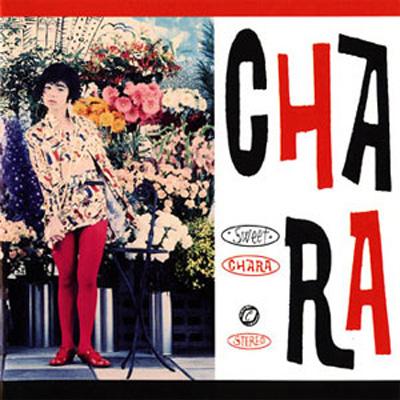
1st Album: Sweet スウィート (1991)
Sweet (1991)
Source

Chara's debut album barely sold over 10,000 copies. Nevertheless, I personally consider this album to a be a diamond in the rough and rank it as one of her best. From the beginning of her career, Chara has played a major role in the formation of her songs, especially the lyrics. Similar to many of her future albums, Chara had a hand in writing the lyrics for all the songs on this record.

Although her early 20-something cheekiness peaks through, this album also marks the establishment of her trademark contemplative, heart-wrenching love songs.

"Rainbow Gossip" is a strong opener with a funky tune which talks about the power of love and female confidence (I used it for my Character Street video). Aside from "No Toy"—the weak link of this record—its fast-paced nature contrasts the majority of the tracks on this album. The rest are slower tempo songs or ballads.

"Sweet", the title track, has a distinctly 90's pop sound and funny lyrics about a girl who loves a guy even though he's ridiculously arrogant and obnoxious. I believe everyone can relate to puppy love; it's a cute, peppy song.

Although they're all wonderful, out of the ballads "Usotsuku no ni Narenaide (Don't Get Used to Lying)"; "X-Mas"; and "Break These Chain" (yes, the grammar of the title is incorrect) are my favorite. The title of "Usotsuku no ni Narenaide" is pretty clear. The song speaks of the pain of being lied to by a lover, but loving them anyway. Chara's childlike voice brings home the emotion and makes the song all the more painful. Similarly, "X-mas" is a saccharine balled which speaks of heartache in the form of unrequited love.

"Break These Chain", about a painful relationship, is a fan favorite and the star of the record for me. Chara's voice switches from babylike to raspy without transition on this track, so its an acquired taste. Nevertheless, I love the emotion in the song, which truly transcends language. 

Top picks: With the exception of "No Toy", I love all the tracks on this album. 

Soul Kiss (1992)
Source

2nd Album: Soul Kiss ソウルキス (1992)

Despite the innocent look of the album jacket, Chara ditched the innocent exterior she presented in Sweet for an edgier, almost risque vibe by the release of Soul Kiss. At this point, she was well-known for her skimpy outfits and onstage grinding.

This album was considerably more successful than Chara's debut, but I have less favorites from this record. Still, its a solid album with a good balance between soft rock songs and ballads.

"Are wa ne (Is that right)" and "Soul Kiss xxx" are my favorite ballads. To me, "Are wa ne" sounds like the voice of a girl who's been led on a number of times. It's a sombre song, but the music is lovely. Like many of Chara's songs, "Soul Kiss xxx" refers to uncertainty in regards to relationships, namely the difficulty of finding the right person.

"Ai no Jibaku Souchi (Love Suicide Bombing Gear)" is the crazy number of album (if not apparent by its title). The song features famous Japanese guitarist Rolly Teranishi (Suicide Club) who also lends his vocals on the track. Everyone wants to be in the sweet "strawberry land" of love, but sometimes we self destruct on the way there or soon after we arrive!

Top picks: "Are wa ne (Is that right)"; "Ai no Jibaku Souchi (Love Suicide Bombing Gear)"; "Soul Kiss xxx"

2015-10-15

Black Women Thrive: Interview with English Teacher Melissa Da Costa

Da Costa (left) at the summit of Mt. Fuji with friends.
Without a doubt, Fujisan (富士山)or Mount Fuji is the most salient symbol of Japan. It dominates a large area of Honshu, the nation's "Main Island", and at 12,888 ft (3,776 m) it is the highest point in the country. Unsurprisingly, the majestic mountain was designated a UNESCO Worth Heritage Site in 2013.

Many dream of climbing Mt. Fuji and reaching its summit, and the Japanese believe reaching the top of Fujisan will bring the climber good luck. But despite the sacred nature of the climb and its popularity, Melissa Da Costa, an expat English teacher in Japan, wasn't that interested in the climb, "It was never something that I considered doing."

Nevertheless, she went on the trip to Fuji, and despite the difficulties on the way, made it to the top.

The climb to the summit of Mt. Fuji is just one of many adventures Da Costa has experienced since moving from the UK to Japan. She come to Japan in 2013 since she was interested in the culture. Like many, her introduction to Japan came through anime; however, her interests eventually began to revolve around Japanese history rather than pop culture. 

The majestic Fujisan with vibrant flowers.
Source
"I like my [H]istory; I've been to various sites in Japan and do like my castles...Nagoya Castle was pretty nice."

After visiting the blogs of people who have taught English abroad, Da Costa decided relocate to Japan and do the same. She is currently based in the small city of Odawara, yet previously lived in Hiroshima.

"My favorite city will always be Hiroshima. I lived there for one year. I like that [al]though it was a city, it wasn't crazy like Tokyo. It's a kind of charming place and if I could go back I would."

During her Hiroshima days, she used to travel to a different prefecture nearly every month. So far, she's been to several places in Kyushu (i.e., Kagoshima, Oita, Fukuoka) and Chugoku (i.e., Yamaguchi, Okayama).

"I realise that I've travelled to more places in Japan than I have in England," Da Costa says.

2015-10-13

Hawaii State Art Museum

"Hanauma Bay Series: Ronin Samurai" (1982), a watercolor by Masami Teraoka (1936-).
This piece is done in Japanese Ukiyo-e influenced style and is my favorite piece in the museum. 
The Hawaii State Art Museum is comprised of four galleries—the Diamond Head Gallery, the Ewa Gallery, the Sculpture Lobby, and the Sculpture Garden—and features the work of over 100 Hawaiian artists, most of which are Asian American (i.e., Chinese or Japanese), or who moved to Hawaii and spent a significant time in the state. Although the majority of the pieces were created in the 1960s, there are a few newer works of art. 

The history of the museum is quite interesting. The building began as a hotel in 1872, which was converted into a YMCA in 1917, then subsequently used as a military outpost during WWI. Since then, it has became the Hawaii State Art Museum and the home of the Hawaii State Foundation on Culture and the Arts. It is also a popular wedding venue, likely because of the gorgeous scenery.

Patrons can visit the museum for free; therefore, there is no excuse not to stop by if you're in downtown Hawaii! While the gallery is small, the artwork is beautiful and rich.

2015-10-06

Music Musings: Tokyo Ska Paradise Orchestra (1990-1996)

Tokyo Ska Paradise Orchestra, 2015
Source
Music Musings: Tokyo Ska Paradise Orchestra (1997-2003) can be found here.

Since hearing their track "Lupin the 3rd '78" when I was in junior high, Tokyo Ska Paradise Orchestra has became my favorite Japanese instrumental group, as I've expressed before. Now a nine-piece band, TSPO began as a collective of musicians in the mid-1980s, which essentially whittled itself down to 10 members by 1990. Over the years, there has been changes in the line up; as of now, six of the original members remain.

Like any band, TSPO's sound has also changed and evolved over the years. This post focuses on the years between their major debut in 1990 to the mid-90s, a time period marked by their progression from an unapologetically ska and jazz sound to a little more mainstream.

Skapara Tõjõ (1990)
Source
1st Album: Skapara Tõjõ スカパラ登場 (1990)
Debut albums are sometimes a dark point in the discography of even the most popular musicians as oftentimes they reflect an unrefined air—not the case with TSPO. While modestly named Skapara Tõjõ or Skapara's Introduction, TSPO's first album is explosive and uncompromisingly in-your-face. The unfiltered background noise of TSPO clapping, cheering, and enjoying their music as they play it, characteristic of this time period of their discography, gives an interesting live effect to tracks like "Vampire", "Kozo no Koshin", and "Uhan no Hito".

Although it isn't the best reflection of his singing ability, "Nigai Namida" is a great introduction to Cleanhead Gimura's vocals. "Getsumen Butou", "Inishie no Hana", and "Kimi to Boku", the more tranquil tracks on the album, give the listener a quietly sinister, relaxing seaside vacation, and lullaby feel respectively; although lower tempo, all three songs are as charming as the heavier numbers. "Tin Tin Deo", my favorite song on this album, is a great mixture of subtile and upbeat. A great cover of Ray Charles' "Hit the Road Jack" is also included on this album.

Top picks: "Getsumen Butou"; Inishie no Hana"; "Tin Tin Deo"


Tokyo Ska Paradise Orchestra (1990)
Source
2nd Album: Tokyo Ska Paradise Orchestra 東京スカパラダイスオーケストラ (1990)
A prolific year for TSPO, the band's self-titled second album of 1990 is a short collection of six songs. "Skaravan" has become a fan favorite and the upbeat track marked by it's distinctive solos (my favorite being the piano solo) finds its way into most TSPO live concerts even now. "Pedorazu", a cover of the Tetris theme, makes for a great album opener and is an awesome rearrangement of the original. "Christmaska", a cover of "Joy to the World", is also a lovely homage to its predecessor. "Just a Little Bit of Your Soul" is a tune rooted in funk, and makes a reappearance on Grand Prix (1995).

Top picks: "Pedorazu", "Skaravan", "Just a Little Bit of Your Soul"

Tokyo Ska Paradise Orchestra Live (1991)
Source
1st Live Album: Tokyo Ska Paradise Orchestra Live 東京スカパラダイスオーケストラライブ (1991)

The garish cover of TSPO's first live album is an honest reflection of its sound. The band's ability to entertain through their sound is apparent in their constant freestyling and explosive harmonies. Vocalist Gimura shines in this live album with his authentic cover of Bobby Bland's "36-22-36". Although short, "Youkai Ningen" is definitely my favorite track on this album and shows off Gimura's unique vocal range beautifully.

Top picks: "Shot in the Dark", "36-22-36", "Youkai Ningen"

2015-10-03

Ameyoko (アメ横): A Sweet Tooth's Paradise

Ameyoko's North Entrance.
Source
On my first full day in Tokyo, I visited Sensõji Temple, Kappabashi, Ueno, and Tokyo Character Street. Aside from the large Ueno Park, I believe Ameyoko(アメ横)is the most well-known tourist spot in the Ueno area. From Asakusa, I walked to Ueno, then took the train from Okachimachi to Tokyo Station.

A man selling chocolate and other candies.
On day 1, I was out and about for nearly half the day. Unfortunately, somewhere between Kappabashi and Ueno, my portable charger and wi-fi device both died! As a result, I was unable to send pictures and videos on my phone to my Dropbox, and my phone was too full to take pictures. So, I was left with my cheap, nearly decade old point-and-shoot...which also ran out of batteries! Thankfully, I was able to score new ones from the Yodobashi Camera (an electronic store chain) close to Ueno Station.

Ameya-Yokochõ(アメヤ横丁)—Ameyoko for short—is situated along the metro tracks between Ueno and Okachimachi stations. It used to be a marketplace for goods from America (americaアメリカ) right after WWII; however, these days Ameyoko sells discounted clothes, street food, dried goods, and sweets. Candy is a popular item sold in the area, and I doubt you can find it cheaper in any other part of Tokyo.