Showing posts with label chara. Show all posts

2017-07-21

Album Review: Chara - Sympathy (2017)

Watabiki Miwa aka Chara
Source: chara-web.net
Watabiki Miwa—much better known as Chara—just celebrated over 25 years as an established artist. I have written extensively about her work here and will continue to chronicle and review her discography in future posts. However, I couldn't resist the opportunity to review her latest album Sympathy, released earlier this week. 

Although Chara will be 50 next year, and has spent almost half her life in the music industry, I believe Sympathy is indelible proof that her sound remains fresh and innovative. Sympathy includes some obvious weak links, but the star tracks shine through and demand several repeats, which makes this bittersweet album a whimsical summer gem. 

Sympathy (2017)
Source: musicman-net.com
While her sound has evolved and gone through many phases of experimentation through the years, one thing I love about Chara is that she's always unmistakably herself and never fails to be daring with her work. Sympathy is clearly a sensual album, a rare theme to spot in the work of a Japanese artist of Chara's generation. 

However, love and sensuality has been a running theme in Chara's work from her flirty, borderline exhibitionist early-90s days to her now more refined sultriness. Occasionally paired with her other common theme of innocences, this album serves romance on a wide, delectable gradient. To use an example from Chara's discography, this album is as if Madrigal (2001) had a baby with Chara's 2010s sound. There is a funky playfulness here that is hard to miss. 

Naturally, perfection is unattainable, so let's start with the weaker tracks in the album.

2015-12-01

Music Musings: Chara (1998-2005)

Strange Fruits (1999)
Source
Music Musings: Chara (1990-1997) can be found here.

7th Album: Strange Fruits ストレンジ・フルーツ (1999)

Produced completely by Chara, Strange Fruits is a noticeable about-face when compared with its predecessor Junior Sweet (1997).  It's a melancholic, moody album. Nevertheless, it is my favorite album of this time period.

"Atashi wa Koko yo (I'm Here)" and "Duca", the two high tempo tracks of the record, are deceivingly positive. Rather than the simple music box pop tune, I feel the creativity behind "Atashi wa Koko yo" lies in the irony of the lyrics against the positive-sounding music; the chorus goes "I am here [for you], I want to cry forever." Chara likens the inability to grab the sun and sky to the unreachability of a lost love.

Like several of Chara's tracks, "Duca" has a kiddish tone. To the beat of fun, bouncy music, a little girl (the role Chara takes for this song) talks about walking with her father, "new" (step?) mother, and pet (dog?) Duca. As most children wonder, the girl contemplates whether the happiness will fade in adulthood while she enjoys ice cream.

Of the remaining slow, somewhat gloomy songs, "70% Yuugure no Uta (70% Evening Song)"; "Hikari to Watashi (The Light and Me)"; and "Oburaato (Oblate)" are the winners. "70% Yuugure no Uta" was one of the first songs of Chara's that I heard years ago, and I still love how relaxing it is, as its title suggests. The image of contemplation under the rain is depressing, but it's a lovely listen.

"Hikari to Watashi" is a gorgeous, touching song that, like most of the songs on this album, relies heavily on Chara's voice, a musical representation of different forms of pain, losing the "magical" spark of life in this case. It's a difficult song to put into words as, more than music, it's lyrical emotion. I highly recommend giving the music video a watch if you can find it.

"Oburaato" is somewhat of an acquired taste for those unacquainted with Chara's occasional extreme vocals. Her voice winds up to a near whine and falls deep, close to her speaking voice, in a short time spans throughout this track with minimal music. The turbinate nature of the song is a beautiful match to the turbulent nature of the love she describes. 

Top picks: It's a beautiful album as a whole.

Chara Live 97-99 Mood
Source
1st Live Album: Live 97-99 Mood ライブ・97−99・ムゥド (2000)

With the birth of her son in late 1999, 2000 was a somewhat calm year for Chara, albeit not without releases. 

The tracks on this 2-disc album were taken from two concerts: Chara Junior Sweet Tour (1997) and Chara Concert Tour Duca & the Aurora Band (1998). Although I love all the songs on this one, the Junior Sweet tour was amazing; therefore, I'm quite partial to those songs.

Naturally, the songs take on a different flavor in concert form. Many of my favorites like "Happy Toy"; "Watashi wa Kawaii Hito to Iwaretai (I Wanna Be Called Cute)"; and "Time Machine" got a super soulful facelift.

Top picks: "Happy Toy"; "Watashi wa Kawaii Hito to Iwaretai (I Wanna Be Called Cute)"; "Time Machine"

2015-10-17

Music Musings: Chara (1990-1997)

Chara with her children Himi and Sumire
in the background, 2015
(Source)
Music Musings: Chara (1998-2005) can be found here.

My love for songstress and actress Miwa Watabiki—also known as Chara—began when I heard "Yasashii Kimochi" over a decade ago. As I've lightly recapped her history before, there's no need for me to gush too much about her here. 

After her school days, a time when she was a well-known chatterbox or charachara (ちゃらちゃら), Watabiki left for the big city. After working as a rollerskating waitress and backing musician in the 80's, she gave her first solo live performance in 1990 and released her debut album in 1991 as Chara, the shortened form of her old nickname "Charabiki". 

This post chronicles Chara's main releases between her debut and 1997, the undisputed peak of her career in terms of popularity.

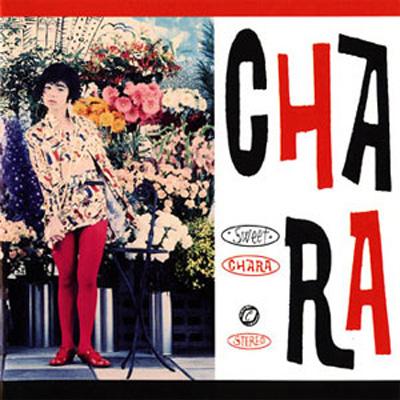
1st Album: Sweet スウィート (1991)
Sweet (1991)
Source

Chara's debut album barely sold over 10,000 copies. Nevertheless, I personally consider this album to a be a diamond in the rough and rank it as one of her best. From the beginning of her career, Chara has played a major role in the formation of her songs, especially the lyrics. Similar to many of her future albums, Chara had a hand in writing the lyrics for all the songs on this record.

Although her early 20-something cheekiness peaks through, this album also marks the establishment of her trademark contemplative, heart-wrenching love songs.

"Rainbow Gossip" is a strong opener with a funky tune which talks about the power of love and female confidence (I used it for my Character Street video). Aside from "No Toy"—the weak link of this record—its fast-paced nature contrasts the majority of the tracks on this album. The rest are slower tempo songs or ballads.

"Sweet", the title track, has a distinctly 90's pop sound and funny lyrics about a girl who loves a guy even though he's ridiculously arrogant and obnoxious. I believe everyone can relate to puppy love; it's a cute, peppy song.

Although they're all wonderful, out of the ballads "Usotsuku no ni Narenaide (Don't Get Used to Lying)"; "X-Mas"; and "Break These Chain" (yes, the grammar of the title is incorrect) are my favorite. The title of "Usotsuku no ni Narenaide" is pretty clear. The song speaks of the pain of being lied to by a lover, but loving them anyway. Chara's childlike voice brings home the emotion and makes the song all the more painful. Similarly, "X-mas" is a saccharine balled which speaks of heartache in the form of unrequited love.

"Break These Chain", about a painful relationship, is a fan favorite and the star of the record for me. Chara's voice switches from babylike to raspy without transition on this track, so its an acquired taste. Nevertheless, I love the emotion in the song, which truly transcends language. 

Top picks: With the exception of "No Toy", I love all the tracks on this album. 

Soul Kiss (1992)
Source

2nd Album: Soul Kiss ソウルキス (1992)

Despite the innocent look of the album jacket, Chara ditched the innocent exterior she presented in Sweet for an edgier, almost risque vibe by the release of Soul Kiss. At this point, she was well-known for her skimpy outfits and onstage grinding.

This album was considerably more successful than Chara's debut, but I have less favorites from this record. Still, its a solid album with a good balance between soft rock songs and ballads.

"Are wa ne (Is that right)" and "Soul Kiss xxx" are my favorite ballads. To me, "Are wa ne" sounds like the voice of a girl who's been led on a number of times. It's a sombre song, but the music is lovely. Like many of Chara's songs, "Soul Kiss xxx" refers to uncertainty in regards to relationships, namely the difficulty of finding the right person.

"Ai no Jibaku Souchi (Love Suicide Bombing Gear)" is the crazy number of album (if not apparent by its title). The song features famous Japanese guitarist Rolly Teranishi (Suicide Club) who also lends his vocals on the track. Everyone wants to be in the sweet "strawberry land" of love, but sometimes we self destruct on the way there or soon after we arrive!

Top picks: "Are wa ne (Is that right)"; "Ai no Jibaku Souchi (Love Suicide Bombing Gear)"; "Soul Kiss xxx"

2015-07-08

Concert Review: Chara (live at the Urban Simple Life Festival - Xinyi 信義)

Chara is known for her childish "whisper" voice.
At 47, she should also be known for her inability to age!
She plays the guitar and piano, and writes nearly all of her songs.
(Photo from her Facebook page).
Chara (real name: Watabiki Miwa 綿引美和), is hands-down my favorite female Japanese singer. I discovered her music as a junior high student when I was looking for new Japanese artists to listen to. Immediately, I was mesmerized by her soft, slightly raspy voice which occasionally takes on a husky, almost harsh tone. Chara's speaking voice is actually somewhat deep, yet it often transforms into a light, high-pitched tone when she sings.

I admire the personal nature of Chara's music and her willingness to share her deep inner feelings in her lyrics. Innocence (Sweet), intimacy (Junior Sweet, her performance of this song with TSPO on the left), and divorce (Breaking Hearts) have all been subjects of her songs. I admire Chara because no topic appears to be "off limits" for her when writing music. Chara's creativity transcends her sound; to add a sense of childlike innocence to her songs, she often uses the male personal pronoun boku (僕).

Chara's thoughtfulness in regards to her music hasn't changed since her major debut in 1990, yet her style has evolved through many phases: mainstream with a touch of black gospel in the early 90s; acoustic-heavy in the mid to late 90s; experimental indie in the early 2000s; mainstream pop in the mid 2000s; and mostly popish experimental indies style today. Nevertheless, she has always distinctly remained herself.

Chara peaked in popularity in the mid-90s after her lead role in the successful Shunji Iwai film, Swaillowtail Butterfly. In the film, she played Glico (yes, taken from the snack company), a Chinese immigrant turned lead singer of the fictional Yen Town Band; to accompany the movie, Chara and the Yen Town Band released a record which took first place on the Japanese Oricon music chart for quite some time. On the right is a clip of her gospel-like performance of Happy Toy from the 1997 Asasaka Blitz tour, not long after the movie was released. (A couple members of the Yen Town Band played support on the tour, and TSPO's founder ASA-CHANG was on percussion. He helped produce some of her songs as well). Despite her emergence as a well-known singer, actress, and fashion icon, after the 90s, Chara focused on motherhood and preferred a more indie existence as a musician.

Yasashii Kimochi (やさしい気持ち; Kind Feelings) - one of her most popular songs, second only to Swallowtail Butterfly - was the first song of her's that I heard all those years ago. Still, the dreamlike feeling of the song sounds fresh to me. To my delight, in 2013 Chara released Jewel, a self-cover album which includes Yasashii Kimochi, Swallowail Butterfly, and 10 other songs. I thought it would be amazing to watch her perform after Jewel was released because, naturally, she would be playing several songs from across her discography that she hadn't played in a few years. Little did I know I'd get an opportunity to see her without having to go to Japan!