Showing posts with label Tokyo Ska Paradise Orchestra. Show all posts

2018-06-24

Concert Review: Tokyo Ska Paradise Orchestra “Skanking Tour” in Matsuyama

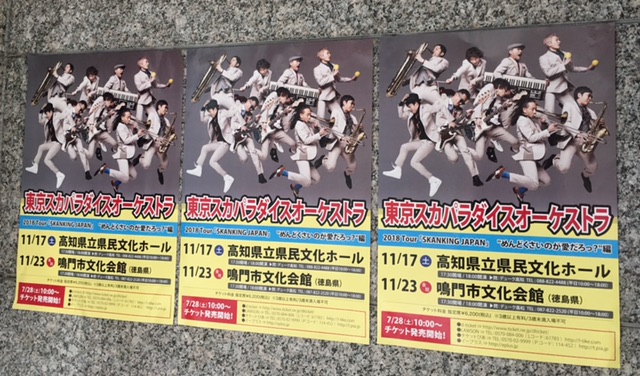
Posters at Matsuyama's w Studio Red.


(Click here for other posts about Tokyo Ska Paradise Orchestra)

Entering the venue.
I finally (finally!!!) got the chance to see Japan’s legendary Ska band Tokyo Ska Paradise Orchestra in Matsuyama, Japan, the last leg of their “Skanking Japan” livehouse tour.

I always prefer to see bands at their “home base” or home country if possible, so I was ecstatic to do so this time. But why Matsuyama? Well...by the time I found out about the tour, all the other locations were sold out! Plus, the date simply worked out better with my schedule. 

TSPO played at Matsuyama’s w Studio RED for two days (6/23 & 6/24); I attended the second show, the last show of the tour. Unfortunately for me, since I bought my ticket from overseas, I had to wait for quite awhile to get in. But the wait wasn’t long, and before I knew it I was inside, waiting for the guys to enter!

2016-07-20

Music Musings: Metafive (2014-Present)

Yukihiro Takahashi (third from left) & Metafive - Source: Natalie.mu
Originally posted on the now-defunct Japanistas.com.

With his penchant for classy hats and Thom Browne suits, friendly grin, and slightly raspy timbre, 64-year-old Yukihiro Takahashi hardly appears to be a techno composer or a drumming powerhouse — but appearances can be deceiving!

Beyond Takahashi’s stylish exterior lies a lifelong musical innovator with an impressive number of successful projects under his belt. An industry pioneer, Takahashi has helped mold electronica, j-pop, synthpop, new wave and even hip hop music as we know it today, and he continues to do so through his super group Metafive: recording artist and producer Keigo Oyamada aka Cornelius; Japanese-Swedish singer/songwriter Leo Imai; electric instrumentalist, Tomohiko Gondo; former Denki Grove member and DJ, Yoshinori Sunahara; and DJ and record producer, Towa Tei.

Takahashi’s formal introduction to the music industry came from his time as the drummer in the Japanese British glam rock-inspired group Sadistic Mika Band, known best for their acclaimed 1974 album Kurofune(黒船), “Black Ships”.


As the first Japanese band to tour the United Kingdom, the Sadistic Mika Band’s unique sound drew attention, especially regarding their ability to create Western-style music in an undoubtedly Japanese manner. They went on to appear on both BBC Radio and BBC TV.

Nevertheless, The Sadistic Mika Band in its original form disbanded in the mid-70’s, yet there have been a number of revivals of the band under several names over the years, including a 2006 revival with Kaela Kimura in Mika Kato’s place.

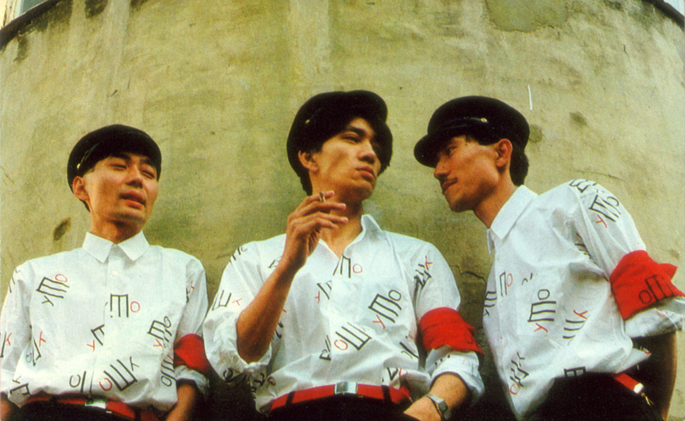
After Sadistic Mika Band’s disbandment, Takahashi went on to begin a successful solo career. Simultaneously, he was a member of world-renowned group the Yellow Magic Orchestra along with bassist, producer, and songwriter Haruomi "Harry" Hosono, and composer, pianist, and two-time Golden Globe, Academy, and Grammy award-winner Ryuichi Sakamoto.

The Yellow Magic Orchestra in the early 80’s. – Source: Factmag.com
Created by Hosono, YMO was meant to be a temporary project, but after gaining international recognition, the band played spectacular lives and recorded esteemed albums together for several years.

2015-11-07

Music Musings: Tokyo Ska Paradise Orchestra (1997-2003)

Moods for Ska ~We Don't Know
What Ska Is!~ (1997)
Source
Music Musings: Tokyo Ska Paradise Orchestra (1990-1996) can be found here.

4th Compilation Album: Moods for Ska ~We Don't Know What Ska Is!~ ムース・フォー・トーキョー・スカ 〜ウィ・ドント・ノウ・ワット・スカ・イズ!〜 (1997)

Nope, I did not review TSPO's first three compilation albums as they are rare and quite difficult to locate. I believe this one, although their fourth, is the first worth noting. This album is a hodgepodge of live and studio tracks, and contains many fan favorites like "Pedorazu" and "Monster Rock".

I see this album as a good intro to TSPO; although it's nearly two decades old, many of the songs on this record are played by the band at nearly every concert they play these days, like "Shot in the Dark", "Burning Scale", and "Skadon", all extremely lively songs. 

"Mr. Mystery Shuffle" is my favorite track with vocals on the album. It sticks to the traditional definition of a shuffle beat wise, yet is anything but mundane. Cleanhead Gimura is responsible for the vocals on this one, a posthumous release. If you read part one of this series, you already know I'm a sucker for his unique vocals, and he sounds borderline evil on this song, so it's particularly delicious to my ears! 

Top picks: There's not a track I don't like!

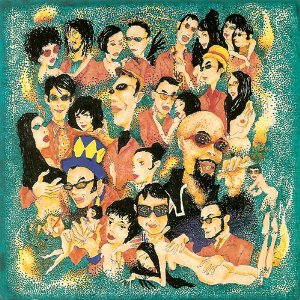
Arkestra (1998)
Source
8th Album: Arkestra アーケストラ(1998)

Arkestra was the first of two albums which included the late Cleanhead Gimura's younger brother Rui Sugimura on vocals. Sugimura was far from his older brother's convenient replacement; his singing and personal style are much different from the elder Sugimura's. Rui Sugimura has a lighter, more pop-oriented voice which also goes well with traditional jazz tunes. Nevertheless, I prefer Cleanhead.

Out of the instrumental tracks, "the PIRATES" is my hands-down favorite. It has a comical, sinisterly nature to it as it sounds like the theme song of a cartoon villain—in a good way, of course. Bassist Tsuyoshi Kawakami is the star on this number. While the bass line is simple, it's harmony with Tatsuyuki Aoki's surgical drumming is extremely catchy and addicting.

The majority of the songs on this record include vocals, a few of which are unfortunately on the generic side. However, Sugimura shines on the last three tracks: "Funade no Machi (Sailing Town)"; "Hikari (Light)"; and "Dear My Sister". The harmonica solo close to the beginning of "Funade no Machi", reminiscent of country music, might initially seem out of place. Nevertheless, one of my favorite aspects of this track is the arrangement; I especially like the radio-like filter over the bridge portions. On the foundation of a simple, slow beat, the musical style of the foreground instruments changes. For instance, when Sugimura sings of a "symphony in the sky" the music turns symphonic.

Generally, "Hikari" is driven by Sugimura's melancholic vocals. It's a slower track about saying goodbye, but I find it more soothing than sad. The music is minimalistic to an extent at the beginning, similar to the sound of midi music files, yet the saxophones pick up toward the end

"Dear My Sister" is a favorite of mine because of the lyrics; there's nothing too remarkable about it musically. It's a fun, inspirational song essentially about leaving loneliness behind, and the upbeat tempo makes it fit nicely on my workout playlist. Sugimura's fast, almost rapping vocals adds to the positive mood the song evokes. 

During the Arkestra tour, drummer Tatsuyuki Aoki died after an apparent suicide and was replaced by Kinichi Motegi. Naturally, this marked a significant change in TSPO's music in the drumming department. Motegi is skilled with amazing singing abilities to boot, but lacks the flair and precision Aoki had in my opinion.

Additionally, this was the first album including guitarist Takashi Kato, who I consider to be more talented than the previous Toru Terashi.
Top picks: "the PIRATES"; "Funade no Machi (Boating Town)"; "Hikari (Light)"; "Dear My Sister"

2015-10-06

Music Musings: Tokyo Ska Paradise Orchestra (1990-1996)

Tokyo Ska Paradise Orchestra, 2015
Source
Music Musings: Tokyo Ska Paradise Orchestra (1997-2003) can be found here.

Since hearing their track "Lupin the 3rd '78" when I was in junior high, Tokyo Ska Paradise Orchestra has became my favorite Japanese instrumental group, as I've expressed before. Now a nine-piece band, TSPO began as a collective of musicians in the mid-1980s, which essentially whittled itself down to 10 members by 1990. Over the years, there has been changes in the line up; as of now, six of the original members remain.

Like any band, TSPO's sound has also changed and evolved over the years. This post focuses on the years between their major debut in 1990 to the mid-90s, a time period marked by their progression from an unapologetically ska and jazz sound to a little more mainstream.

Skapara Tõjõ (1990)
Source
1st Album: Skapara Tõjõ スカパラ登場 (1990)
Debut albums are sometimes a dark point in the discography of even the most popular musicians as oftentimes they reflect an unrefined air—not the case with TSPO. While modestly named Skapara Tõjõ or Skapara's Introduction, TSPO's first album is explosive and uncompromisingly in-your-face. The unfiltered background noise of TSPO clapping, cheering, and enjoying their music as they play it, characteristic of this time period of their discography, gives an interesting live effect to tracks like "Vampire", "Kozo no Koshin", and "Uhan no Hito".

Although it isn't the best reflection of his singing ability, "Nigai Namida" is a great introduction to Cleanhead Gimura's vocals. "Getsumen Butou", "Inishie no Hana", and "Kimi to Boku", the more tranquil tracks on the album, give the listener a quietly sinister, relaxing seaside vacation, and lullaby feel respectively; although lower tempo, all three songs are as charming as the heavier numbers. "Tin Tin Deo", my favorite song on this album, is a great mixture of subtile and upbeat. A great cover of Ray Charles' "Hit the Road Jack" is also included on this album.

Top picks: "Getsumen Butou"; Inishie no Hana"; "Tin Tin Deo"


Tokyo Ska Paradise Orchestra (1990)
Source
2nd Album: Tokyo Ska Paradise Orchestra 東京スカパラダイスオーケストラ (1990)
A prolific year for TSPO, the band's self-titled second album of 1990 is a short collection of six songs. "Skaravan" has become a fan favorite and the upbeat track marked by it's distinctive solos (my favorite being the piano solo) finds its way into most TSPO live concerts even now. "Pedorazu", a cover of the Tetris theme, makes for a great album opener and is an awesome rearrangement of the original. "Christmaska", a cover of "Joy to the World", is also a lovely homage to its predecessor. "Just a Little Bit of Your Soul" is a tune rooted in funk, and makes a reappearance on Grand Prix (1995).

Top picks: "Pedorazu", "Skaravan", "Just a Little Bit of Your Soul"

Tokyo Ska Paradise Orchestra Live (1991)
Source
1st Live Album: Tokyo Ska Paradise Orchestra Live 東京スカパラダイスオーケストラライブ (1991)

The garish cover of TSPO's first live album is an honest reflection of its sound. The band's ability to entertain through their sound is apparent in their constant freestyling and explosive harmonies. Vocalist Gimura shines in this live album with his authentic cover of Bobby Bland's "36-22-36". Although short, "Youkai Ningen" is definitely my favorite track on this album and shows off Gimura's unique vocal range beautifully.

Top picks: "Shot in the Dark", "36-22-36", "Youkai Ningen"

2015-06-15

Visiting Aoki Tatsuyuki at Tama Cemetery

TSPO in 1990.
Founder ASA-CHANG (yellow/black hat); TSPO's current leader
Atsushi Yanaka (top left); the late Aoki Tatsuyuki (bottom left);
and late Cleanhead Gimura (in black).
I'm a huge fan of all types of Japanese music, specifically kayokyoku, alternative, and instrumental. One of my favorite Japanese jazz bands is the internationally acclaimed Tokyo Ska Paradise Orchestra - TSPO or Skapara for short. They have a more mainstream sound now which is enjoyable, but I love the blues, funk, and occasionally black gospel influences of their earlier music, all without performing in highly offensive blackface like Rats & Star...

Aoki featured on the July '95
issue of Rhythm & Drums
with Takahashi.
TSPO was formed in in 1985; this marks their 30th year. Their over-the-top, highly energized performances earned them a record deal in 1989. Although the group was founded by percussionist ASA-CHANG (real name: Asakura Hirokazu; 朝倉弘一), at the fore was Cleanhead Gimura (クリーンヘッド ギムラ) whose real name was Sugimura Eiji (杉村英詩). His onstage presence was funny and flamboyant, and his talent was apparent as he was both the group's vocalist and occasional backing musician. Gimura brought TSPO's instrumentals alive in the 1980's until 1994. Unfortunately, he passed away in '95 after a short battle with brain cancer. The last album he actively participated in was FANTASIA (ファンタジア), one of my favorite TSPO records; worthy of its name, its a dreamlike album. I especially love Gimura's vocals on Akai Tori no Ballad (朱い鳥のバラード). The group commemorated him with GRAND PRIX (グランプリ), arguably their first album to target a wide audience due to its mainstream pop sound. Several actors and guest musicians like Takahashi Yukihiro (高橋幸宏), one of my all-time favorites, contributed to GRAND PRIX. I think TSPO made GRAND PRIX a lively album to reflect Gimura's electric personality. 
I was able to score copies of
FANTASIA and GRAND PRIX
from BookOff stores in Tokyo.

Sadly, Gimura was not the only TSPO member to pass away. Their original drummer, Aoki Tatsuyuki (青木達之) died in '99 in apparent Tokyo rail accident. However, as he was struck after walking onto the tracks, his death was widely publicized as a suicide. Nonetheless, there was no suicide note so authorities did not conclude he took his own life. Either way, I feel it was an extremely unfortunate event since Aoki was an incredibly innovative and sharp drummer, composer, and DJ. While TSPO did not release an album in his name, they expressed their sadness regarding his untimely death on their live album Ska Evangelists on the Run. I think Motegi Kinichi (茂木欣一) - Aoki's successor and TSPO's current drummer - is extremely talented as well (he has a great singing voice to boot), but I still prefer Aoki.
TSPO's European tour poster.
Six of the eleven original members
remain.

I have yet to see a TSPO show, but thanks to technology I have watched several of their performances, including ones from the early 90's. Below is a clip of TSPO performing a cover of the late Bobby Bland's 36-22-36 on a street in Shibuya, Tokyo on New Year's Day, 1990 (a little over a month before I was born!).

TSPO is going on a European tour next month, so if you have an opportunity to see them, make sure you do! I certainly wish I could.


It might sound strange, but I wanted to visit the graves of Cleanhead Gimura and Aoki Tatsuyuki when I knew I would be going to Tokyo. I searched extensively but couldn't find where Gimura was buried. On the other hand, I quickly located the exact location of Aoki's gravesite in the expansive Tama Cemetery or Tama Reien (多摩霊園) through this website