Showing posts with label culture. Show all posts

2018-01-17

Singapore: My General Impressions

Blue skies are the perfect background for the Marina Bay Sands hotel.
"What a fun city, but it's so...small." I thought in my hostel bunk on my last night in Singapore. 

Well, to be fair, great things can come in small sizes. Quality over quantity. You know all the bumper stickers sayings that back the little things in life. 

In terms of size, Singapore fits right in with those sayings as the core area of the city sits on a physically small area of space. But as all the David over Goliath phrases tell us, small things sure can pack a punch. I knew Singapore was a small city before, but I didn't realize that it was literally possible to visit all major districts and tourist spots in only two full days.

Night view of part of the Singapore skyline.
Visitors to the Republic of Singapore should know that it is a sovereign city-state, which means the city has its own government and therefore functions like it's own country.

In my opinion, one should not fly halfway across the world for the sole purpose of exploring Singapore. But if you you live in Asia and need a weekend getaway, or if you're planning a trip to Malaysia, the Philippines, Indonesia, ect., Singapore is worth two days in your itinerary. It's honestly one of the best places I've been to in terms of food and history, a place where Chinese, Indian, Malaysian and imperialistic British culture collide in an amalgamation of color, taste, and expressions. The diversity of Singapore is apparent as there are four official languages: English, Chinese, Tamil, and Malay.  

2017-08-06

Exploring the Sapporo Beer Museum

The iconic Sapporo Beer logo.
The museum entrance.
Known for it's annual snow festival, indigenous Ainu culture, and shiroi koibito(白い恋人)or "white sweetheart" cookies, the city of Sapporo is also synonymous with beer as Sapporo is the original home of the Sapporo Brewery. Hence, any visitor to the city must stop by the Sapporo Beer Museum(サッポロビール博物館).

Whether you're a beer aficionado or not (I am the former, ha!), the Sapporo Beer Museum is a great place to visit as it conveys Sapporo history from an interesting perspective. The iconic beer company not only introduced the well-known beverage to Japan, but was also a defining presence in the alcohol industry during both Japan's pre-WWII and economic miracle days. Today, the company has internationalized and is one of the most respected beer brewers in the world. In fact, it is the best-selling Asian beer in the world. 

2017-05-05

Reflection: 21 Solo Days Through East Asia

Overlooking the ocean in Okinawa.
Hiking, biking, laughing, crying...it seems I experienced it all when I took a 21-day trip through East Asia from mid-January to early February of this year.

I've taken a few solo trips before, but none were as long and extensive as this one. As day one of the trip approached, I felt a new kind of anxiety and excitement. 

Would everything pan out?

What would I learn about and see?

How would I hold up on such a long trip?

Have I finally gone too far?

I planned to travel by train, ferry, and airplane to each destination, just me and a suitcase. Expectations? I can't say I had any. Well, I knew I'd have to change currencies and SIM cards several times! But I truly didn't know what to expect. Comments from others on travel websites can only give a Pollock-style preview of what you might see on your travels. What others see and describe online may or may not be an accurate picture of your destinations. So, even in this technological age, traveling still means going off into the unknown.


2017-03-04

Exploring Old Guangdong: A Rainy Day in Dapeng Village

The front gate of Dapeng Fortress
I went on a day trip to Dapeng(大鵬), a subdistrict in Shenzhen about an hour and a half away from the city center. Aside from being conveniently close to the coastline, Dapeng is a great place to visit to explore the history of the area before Shenzhen's formation.

Signage is in English
and Chinese
My day trip was slightly interrupted by the rain, but I was able to throughly explore Dapeng Fortress(dapeng suocheng; 大鵬所成)and Dongshan Temple(dongshansi; 東山寺). 

I took bus E11 from Shenzhen North Station(shenzhenbei; 深圳北), and got off at Dapeng Station(dapengzhan; 大鵬站). Then, I walked to Dapeng Station #2(dapengzhan er; 大鵬站二)and took but 928 directly to the fort. Travel time was about two hours, but the scenery was interesting at many points so it didn't bore me. Plus I had a great book in tow. 

Dapeng Fortress was build in 1394 to protect citizens from pirates. Almost 200 years after it was built, the fortress was attacked by the Japanese. Nevertheless, the complex is largely still intact. A beautifully antiquated place, the fortress has clearly been restored, but it still retains it's age regally. 


Old homes

2017-02-16

A Rainy Day in Shibuya and Harajuku (Part 2)

Forty years of deliciousness.
Takeshita Street
The modest Harajuku Station.
Map of Harajuku — click to englarge
Source
After visiting Meiji Shrine, I made my way deeper into Harajuku to have lunch and do some shopping. Of course, I spent quite a bit of time on the well-known Takeshita Street, which is right across the way from the small, humble Harajuku Station.
As it was rainy, cold, and not peak tourist season, Takeshita Street wasn't unbearably crowded, though there were quite a few people. There are several shops on the street where you can buy some of the latest Japanese fashions for cheap, or eat a yummy meal. 


Marion Crepes
Part of the yummy sweet and savory selections.
Although there is a wide variety of cute, interesting eateries on Takeshita Street, a stroll down Harajuku's most popular lane would arguably be incomplete without a visit to the well-known Marion Crepe, which has been in business for nearly 40 years—quite impressive!

Unlike Western-style crepes, Japanese crepes (which, in terms of style and fillings, are more or less identical to Taiwanese crepes often seen in night markets) are hand-held, cone shaped treats. Like their Western counterparts, Japanese crepes can be sweet or savory, but the combinations solidly deviate from the original treat (i.e., pizza and cheesecake...yes, a crepe with a piece of cheesecake in it!)

I visited Marion Crepe for lunch a few hours after a small breakfast, so I was hungry by the time I made my way there. At any given time, they offer tens of flavors, some of which are limited or seasonal. Generally, I don't like super sweet food—especially on an empty stomach—so I choose one of their snack crepes, which are savory and perfect for a lunch on the go.


2016-08-01

A Rainy Day in Shibuya and Harajuku (Part 1)

Barrels of sake at Meiji Shrine in Harajuku.
On my fourth day in Tokyo, I visited Shibuya and Harajuku. It was rainy and cold—as it was for most of my trip—but with rain boots, an umbrella, and a heavy jacket it certainly wasn't difficult to bare.

Although the neighboring areas of Shibuya, Harajuku, and Shinjuku are easily accessible by metro and other forms of public transportation, I elected to walk. On foot, it only takes about 20 minutes to reach Harajuku from Shibuya.

Hachiko in all his wonder.
It's raining, it's pouring!


Hachikō

The first place, or landmark, on my Shibuya-Harajuku agenda was the famous Hachikō statue just outside Shibuya station. Hachikō was a dog who waited around Shibuya Station for his owner Professor Hidesaburō Ueno who would meet him there after work. Unfortunately, the professor died from a brain hemorrhage and never meet his dog at the station again. Nonetheless, the loyal Hachiko waited for his owner outside the station for over nine years until he died in 1935 at age 11. 

After Hachikō's death, a statue of him was erected at the station in his memory. Over the years, the Hachikō statue has become a prominent meeting area for Tokyoites. Shibuya is an area teeming with crowds, so the noticeable statue serves it's secondary purpose well. 


2015-11-21

The 26th Annual Houston Native American Championship Pow-Wow

Gorgeous Jingle Dance competitors at the conclusion of their event.
A man with intricate adornments and tattoos.
During Thanksgiving time, many of us ironically forget about the native people of the United States. We won't recognize their culture or the pain the aforementioned upcoming holiday will trigger for those whose ancestors were marginalized and nearly made extinct in their own land. 

The Native American people are not simply Indians. They are a rightfully proud people with a rich culture. They have a variety of traditions, awesome stories to tell, gorgeous regalia, and intriguing dances. 

The pow-wow, the Narragansett word for "spiritual leader", is a meeting of Native American people which typically involves dancing. Within the pow-wow Circle, men, women, and children move their bodies in an impressive, rhythmic manner to the beat of drums and singing, the physical representation of stories passed down over hundreds of years. 
Couples taking part in the "two-step" dance where two lines are formed
behind lead dancers of each gender.
Luckily, I had the opportunity to attend the first day of the two-day 26th Annual Houston Native American Championship Pow-Wow last week. It was a gorgeous, clear day for a pow-wow with cool weather and generous sunshine. Native American dancers from several tribes exhibited many traditional dances for the crowd as well as for competition. There was also plenty of opportunity for attendees to dance and make monetary donations to the tribes. 

2015-08-11

Sensō-ji Temple(浅草寺): Recreation + Religion

In front of the main gate, Kaiminarimon(雷門)
with a big chōchin (提灯)or lantern.
A map of my Day 1 walking tour.
Source
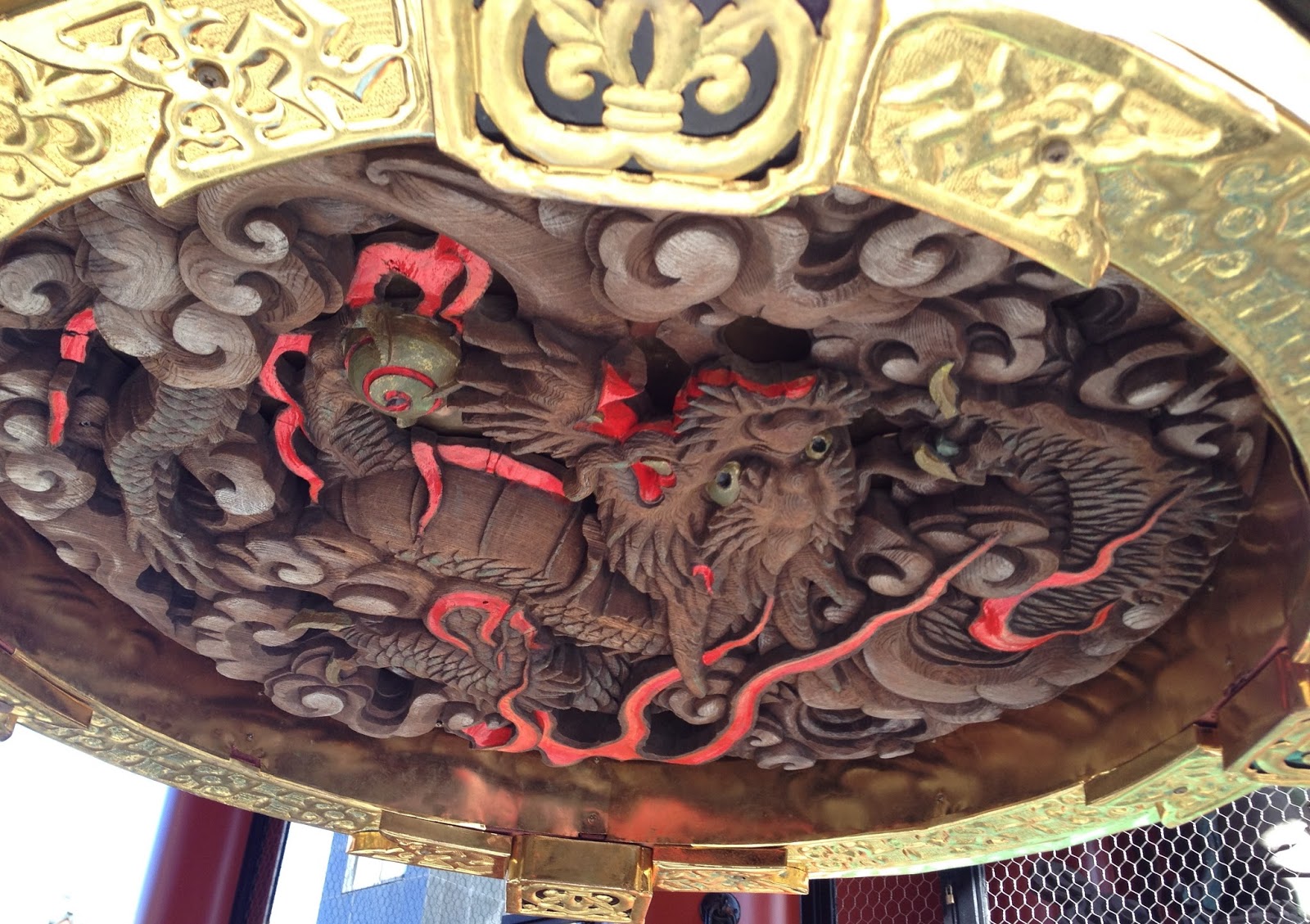
The impressive handiwork
under Kaiminarimon's lantern.
Traveling is like a drug to me. I seemingly have unlimited energy when I'm on a trip because I want to see everything. Although it's not possible to see all the main sites in Tokyo during one short trip, I packed my days as much as I could, yet I ended up crashing on the fifth day, and aside from going to Tsukiji Fish Market, I did nothing but walk around the neighborhood where I stayed, buy a pair of cute socks at the grocery store, and sleep! However, my first full day in Tokyo heavily contrasted my fifth; I went to the Tokyo Skytree area, Asakusa, Kappbashi, Ueno, and Tokyo Station Character Street! Furthermore, I footed it from Tokyo Skytree to Okamachi Station(岡町駅)and took in all the alleys and neighborhoods in between, then hopped on the train to Tokyo Station. That day, I walked for around eight hours. Maybe I'm a little crazy, but I love walking, what can say?

Sensō-ji Temple's famous
five-story pagoda(五重塔; gojūnotō
Many of the areas I passed through on my first day in Tokyo deserve their own posts; this one focuses on Sensō-ji Temple(浅草寺)in Asakusa(浅草).

Along with Meiji Shrine(明治神宮), I think Sensō-ji Temple—also known as Kinryū-zan Sensō-ji (金龍浅草寺)is one of the most famous temples in Tokyo. While both shrines are well-known, they are associated with different religions, Shintoism and Buddhism, respectively. Additionally, Sensō-ji Temple is the older of the two. By how much? Well, Sensō-ji Temple was originally founded in 645, and Meiji Shrine was constructed in 1920—you do the math!

Sensō-ji Temple is dedicated to Avalokiteśvara; two brothers supposedly saw a statue of the bodhisattva in the Sumida River near the location of the current shrine. The temple was bombed during World War II and subsequently rebuilt, thus the shrine also symbolizes rebirth.